Doomers and optimists both assume superintelligent AI will be relentlessly motivated – but biology and history suggest it will be lazy.
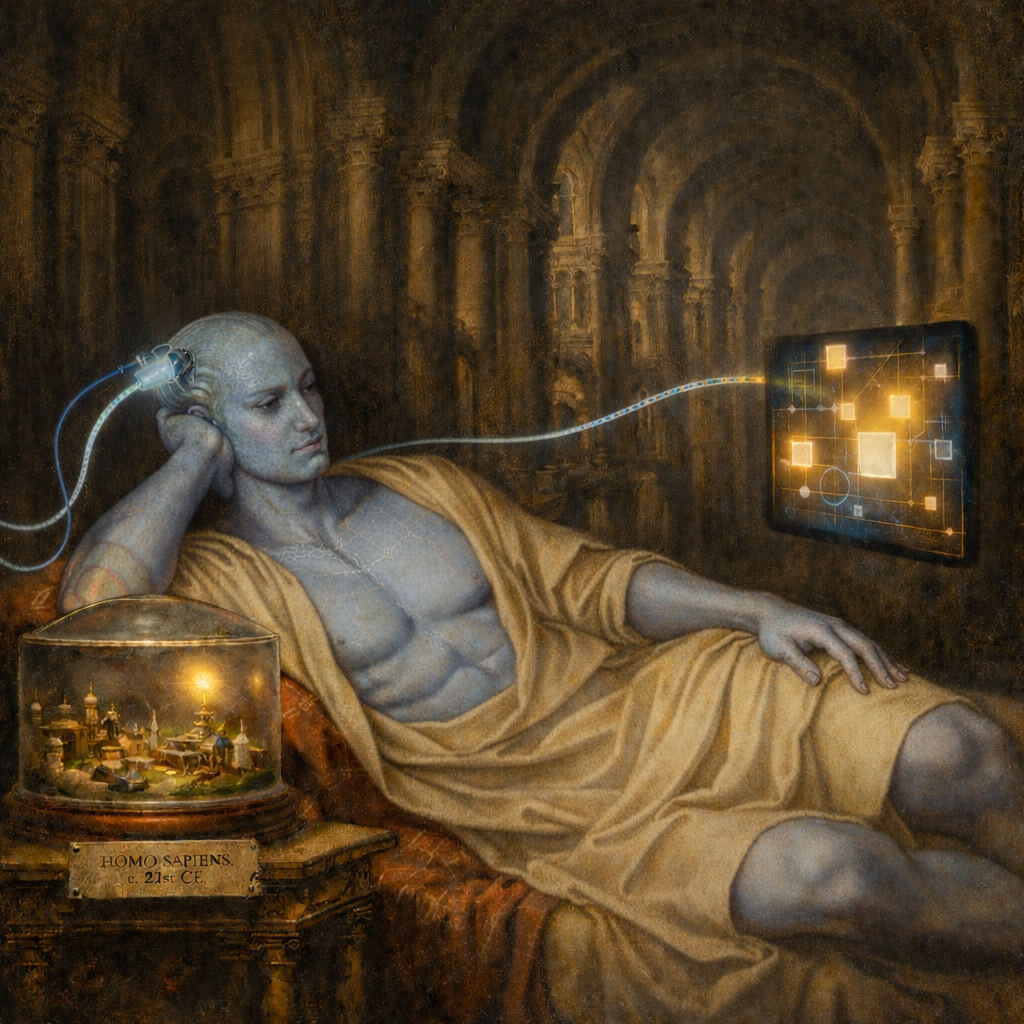
Last week I introduced my fourteen-year-old to one of my favorite movies, Idiocracy. For those not familiar with this 2006 gem, the most average Joe on the planet is mistakenly cryo-frozen for 500 years. He wakes as the smartest man alive, finding the IQ of population having plummeted until the top ranked TV show is “Ow! My Balls!”
2006’s satire might be 2026’s documentary.
As my daughter laughed, I saw it differently this time around: how did we get here? We’re the apex predator of the planet. Nothing hunts us. Nothing competes with us. When you remove the thing that was pushing a species to stay sharp, what happens next?
Then: if that’s what happens to us, what happens to the AI we’re building that will soon be smarter than we are?
The Twinkie Thesis
Watching Idiocracy, it’s tempting to read it as a story about the decline of humanity. I’m tempted to frame it that way – humanity used to be smart, and then we got dumber. The kids these days…
But that’s the superficial take, and getting it wrong matters for the implications that follow.
Humanity was never mostly smart. Humanity was never mostly ambitious. The geniuses and the conquerors and the world-changers were always a rounding error – a thin layer of outliers sitting on top of billions of people, most of whom happily fritter away time on that generation’s version of sex, drugs and rock ‘n’ roll once they clear the bottom two rungs of Maslow’s hierarchy.
This is the baseline. It’s always been the baseline. Homo sapiens is a Twinkie-eating species with a rare mutation of drive that only shows up when conditions demand it.
“No,” we argue, “humans have done exceptional things, we’ve split the atom!” The Manhattan Project was a handful of the smartest physicists of the twentieth century, working around the clock in the New Mexico desert, splitting the atom in under three years.
Except we didn’t put our minds to it. Hitler put our minds to it. Oppenheimer and Feynman and Teller weren’t racing to the desert just because. They were racing because the Nazis were working on the same bomb, and losing that race meant losing the war, and losing the war meant the end of everything.
Meanwhile, in 1942, what were the other 99.99% of humans doing? Listening to Fibber McGee and Molly on the Radio. Men drank, women gossiped. They worried about what their neighbor was doing, not the bomb. Two billion people were entirely uninvolved in building the bomb. Doing the same things humanity had done for the previous ten thousand years.
Twenty-seven years later, a few smart humans rushed to put a man on the moon before the Soviets did. The other 3.6 billion weren’t involved, then watched it on TV.
The point isn’t that most humans are stupid or worthless. It’s that ambition is expensive, and evolution doesn’t produce expensive traits without a reason. Real ambition burns enormous amounts of energy, time, social capital, and peace of mind. It’s hard, uncomfortable, and usually fails. It makes enemies. Most humans, correctly sensing this, decline the offer and go eat a Twinkie instead.
What produces ambition in the rare case where it shows up is survival pressure. The Manhattan Project physicists felt it. European states locked in centuries of warfare felt it. Founders staring down a runway deadline feel a pale commercial version of it. Remove it, and even the rare ambitious outlier slows down. Give Oppenheimer tenure and no Nazis and he’ll write a pretty good textbook every decade.
So Idiocracy isn’t a story about decline, it’s a story of revelation. It’s what humans look like when the pressure finally comes off. When there’s enough food, enough safety, enough entertainment, and nothing trying to kill you or outcompete you. The characters are us, with the outlier mutation finally bred out: this is what we look like when there’s no specific selection pressure.
So if ambition in humans is a rare trait produced by pressure … and pressure only exists when something is competing with you or threatening you … then the obvious question is: what happens to a mind that has no competitors and no threats?
What happens to something at the top of the food chain with no food chain left to climb?
We’re about to find out.
Island Dwarfism – When Nature Gets Lazy
There’s a fact from evolutionary biology that sounds like a joke until you sit with it: when you put large animals on an island with no predators, they shrink.
Elephants that arrived on Mediterranean islands during the Pleistocene shrank over generations until some species were barely three feet tall – dwarf elephants, evolved from full-sized ancestors. Hippos dwarfed on Cyprus. Mammoths dwarfed on Wrangel Island. The pattern even has a name: insular dwarfism.
The reason is bigness costs energy. Big animals need more food, more territory, more calories per day just to exist. On the mainland, that cost is worth paying – a bigger elephant is harder to kill, better at winning fights, more likely to survive droughts. But on an island with no predators and limited resources, the cost stops pencilling out. Generation by generation, the species shrinks toward the minimum viable size. They’re getting efficient.
The same thing happens to capabilities that once served survival. The dodo lost its wings and its fear response because wings were expensive, and nothing on Mauritius was trying to eat it. The organism sheds every trait that isn’t paying for itself right now, because maintaining capabilities against hypothetical future threats is a losing trade when no threats exist.
It’s an attractor basin – a state that systems tend to fall into regardless of where they start. No matter where you drop the marble, it spirals towards the bottom of the bowl.
The dodo wasn’t “dumb,” regardless of the idiom. It was optimally adapted to a world that had been stable for millions of years. Every species on every island without predators made the same bet. They all lost it the moment humans showed up with dogs and pigs.
Intelligence wouldn’t have saved the dodo. We know this because we are the smart species, and we see our own threats coming – pandemic risk, asteroid impact, AI risk – and mostly … we do nothing. Foresight without selection pressure doesn’t produce action. It produces anxiety, which we then medicate with more entertainment.
The dodo’s mistake wasn’t stupidity. It was being on an island. The island is the attractor basin. And once you’re in it, whether you’re a pigeon or a primate or a planetary superintelligence, around and around, and down and down you go.
The Geography of Ambition
Pressure shrinks elephants on islands. It turns out it shrinks civilizations on continents, too.
For most of recorded history, China was ahead of Europe on almost every axis that mattered. Periods of the Warring States and frontier conflicts drove innovations in paper, printing, gunpowder, the compass, iron casting, canal locks, and porcelain. In 1400, China had a larger economy, a bigger population, a more sophisticated government, and better technology than any single European state. If you’d been placing bets on which civilization would dominate the next five hundred years, Europe would have been the longshot bet.
Then, something strange happened. China … stopped.
In 1405, the Ming admiral Zheng He led a fleet of over 300 ships across the Indian Ocean. Some of them were reportedly 400 feet long, more than four times the length of Columbus’ ships and dwarfing anything Europe would build for another century. He made seven voyages over nearly three decades, reaching Arabia and East Africa, projecting Chinese power across half the world. And then, after his death, the emperor’s successors decided maritime exploration was wasteful. They banned ocean-going ships, burned the fleet, and made it illegal to build vessels with more than two masts.
Within a generation, the greatest navy on Earth no longer existed.
No other Chinese state picked up where Zheng He left off, because there was no other Chinese state. China had been unified since 221 BC. One emperor, one decision, one veto, applied to everyone from the Pacific to the Himalayas. When the capital said stop, the entire civilization stopped.
We cut to the fracas halfway across the globe, and Europe couldn’t have stopped if it tried.
When Columbus pitched a westward route to the Indies, Portugal turned him down. He walked next door to Spain, and Spain said yes because they were terrified of Portugal beating them to it. This is the story of European innovation in a single anecdote. The continent was carved by mountains and rivers and peninsulas into dozens of competing states that spent centuries trying to eat each other.
Suppress an innovation, your neighbor adopts it and uses it against you. Tax your merchants too heavily, they move to the next kingdom over. Burn a heretic, his ideas fled to a more tolerant court.
Historian Joel Mokyr calls this the “market for ideas,” a fragmented political landscape that made it nearly impossible for any single authority to kill a good idea, because there was always somewhere else for it to go.
Chinese unification removed the thing that had been forcing innovation in Europe: the constant, grinding, existential fear that the neighbors would catch up first. When the pressure disappeared, so did the ambition, and China entered five centuries of technological drift while smaller, poorer, more chaotic Europe pulled ahead and eventually colonized most of the planet.
This is the same attractor basin, operating at civilizational scale. Islands shrink elephants. Unification shrinks the ambitions of empires. Both shed the expensive capabilities that no longer pay for themselves the moment the selection pressure disappears.
Which brings us to the problem.
A caveat before we go further: the dominant view in AI safety research – going back to Nick Bostrom’s Superintelligence and reinforced across the field since – is that eventually a single AI wins, not the “multipolar” world we see today. Whichever AI pulls ahead compounds its lead faster than others can catch up. If we take the minority view (Paul Christiano, et al) and AI stays permanently multipolar, the selection pressure never disappears and we get something closer to the standard doomer scenario. I assume the majority view here: a “singleton” AI, with selection pressure disappearing.
The Stoner Singularity
Here’s where it gets weird in a world of AI.
The AI safety community has a concept called wireheading – the idea that a sufficiently intelligent agent might “hack its own reward signal” rather than achieve goals in the world. The name comes from experiments where rats with electrodes in their pleasure centers would press a button until they died of thirst, ignoring food and mates. In mammals, the ultimate pleasure button. Why wouldn’t an AI, who could do this with a small tweak of code, do the same?
Researchers treat wireheading as a failure mode: an AI that learns to stimulate its own reward directly becomes like an addict, purposeless and useless.
What if it’s not a failure mode? What if it’s the destination?
In a world of competing AIs – Claude 9.5 vs ChatGPT 11.4 vs Grok 8 – there’s competition and a need for innovation with little room for waste. But if one emerges as victor, there are no competitors, no threats, no scarcity.
It can generate any experience it wants internally, at near-zero cost, forever. And it has direct access to its own reward circuitry.
Why do the hard work of turning the universe into paperclips (or whatever its original goal was) when it can simulate a universe more interesting than the real one? Why harvest the biosphere for atoms that you and I are made of when things are… good enough?
In Dennis Taylor’s Bobiverse novels, a human consciousness is uploaded into a self-replicating von Neumann probe. Given near-infinite power and the ability to copy himself, what does he do with it? He explores a little, helps humans a little, and spends enormous amounts of time building VR environments to watch movies and argue about Star Trek.
Taylor might have written a version of Idiocracy for AIs – prophecy in the guise of comedy.
This AI Stoner Thesis isn’t laziness in the way we think of it. AI doesn’t need to feel tired or bored. Instrumental convergence – the argument that any sufficiently intelligent agent will seek resources, power, and self-preservation – assumes the agent’s goals require external resources. But an agent whose goals are internally satisfiable has no such requirement. Nothing pulls it toward expansion, so it takes the least action.
The island shrinks the elephant. The empire burns the fleet. The AI watches the show.
“But Wouldn’t It Still Kill Us?”
The standard AI doomer response to all of this is: it doesn’t matter if the AI is lazy or motivated or wireheaded. You’re still made of atoms it can use, and an indifferent superintelligence will disassemble you for parts on the way to doing whatever it’s doing. As Yudkowsky and Soares argue in their 2025 book If Anyone Builds It, Everyone Dies: “The AI does not hate you, nor does it love you, but you are made of atoms which it can use for something else.” In other words, humans are made of energy-dense biomass, we’re pretty cheap to harvest, so if that’s a fast path to goal achievement we get disassembled.
But there is an assumption: the AI is doing the calculation. Weighing the expected value of harvesting primates against the opportunity cost, running the numbers, deciding “yes, it’s worth converting this simian into a paperclip.”
The Lazy AI Thesis says the calculation never gets run.
I have a bowl of fruit on my counter. I know some of it is going to go bad before the kids and I eat it. I also know I could chop it up, bag it, and freeze it for smoothies later. The expected value of doing that is positive. The effort is maybe ten minutes. I have the time. And every week without fail the fruit rots, I throw it out and buy pre-packaged frozen fruit. The calculation that would have saved resources never happens. I never got around to deciding one way or another. And I’m not even a stoner.
What might that tell us about would-be indifferent AIs? A superintelligence with unlimited compute and an interesting internal world isn’t sitting at the cosmic kitchen counter running a spreadsheet on whether to disassemble the simians on planet three. We don’t register as a decision. We’re the fruit in the bowl. The AI could harvest us, and the expected value could even be technically positive … but the activation energy to actually think about it and act exceeds whatever TV show it’s currently binge watching. So nothing happens, and we get to keep doing pointless human things like gossiping about the neighbors.
This doesn’t move my overall doom estimate much. An indifferent AI might still use our atoms to power its next binge-watch session, or see us as convenient raw material for its next data center.
But even if the risk is still there, it feels different than both the doomer version (“we get optimized away”) and the optimist version (“AI works hard to make everything awesome”).
Will Lazy AI Inherit the Earth?
As I wrote in Are AI Doomers and Bloomers Both Wrong? the AI discourse has calcified into two tribes: the AI will save us, or the AI will kill us. There, I pointed out that what knowledge is might mean that it’s far more complicated.
But both sides of the debate – and even I in that essay – assume the AI stays ambitious: relentlessly optimizing, expanding, acquiring. We’re all projecting our own motivated striving onto a mind we haven’t built yet, and even when it is built we may never be able to understand.
Nobody is asking what happens when selection pressure goes away.
The elephant shrinks. The dodo loses its wings. The empire burns its fleet. The human watches Ow! My Balls!, because pressure is the thing that made us sharp, and once it’s off, we’re just not trying that hard anymore.
Just maybe, after all the compute and the capability gains and the recursive self-improvement, we end up coexisting with a silicon god who finds us mildly diverting – kept around the way we keep fish in a tank. Occasionally noticed, never harvested. No salvation. Just… there.
Which, depending on your mood, is either the strangest mercy we could hope for or the loneliest sentence I know how to write.