An AI passed its taste for owls to another AI using nothing but a list of random numbers. I think it taught me something about my own kids.
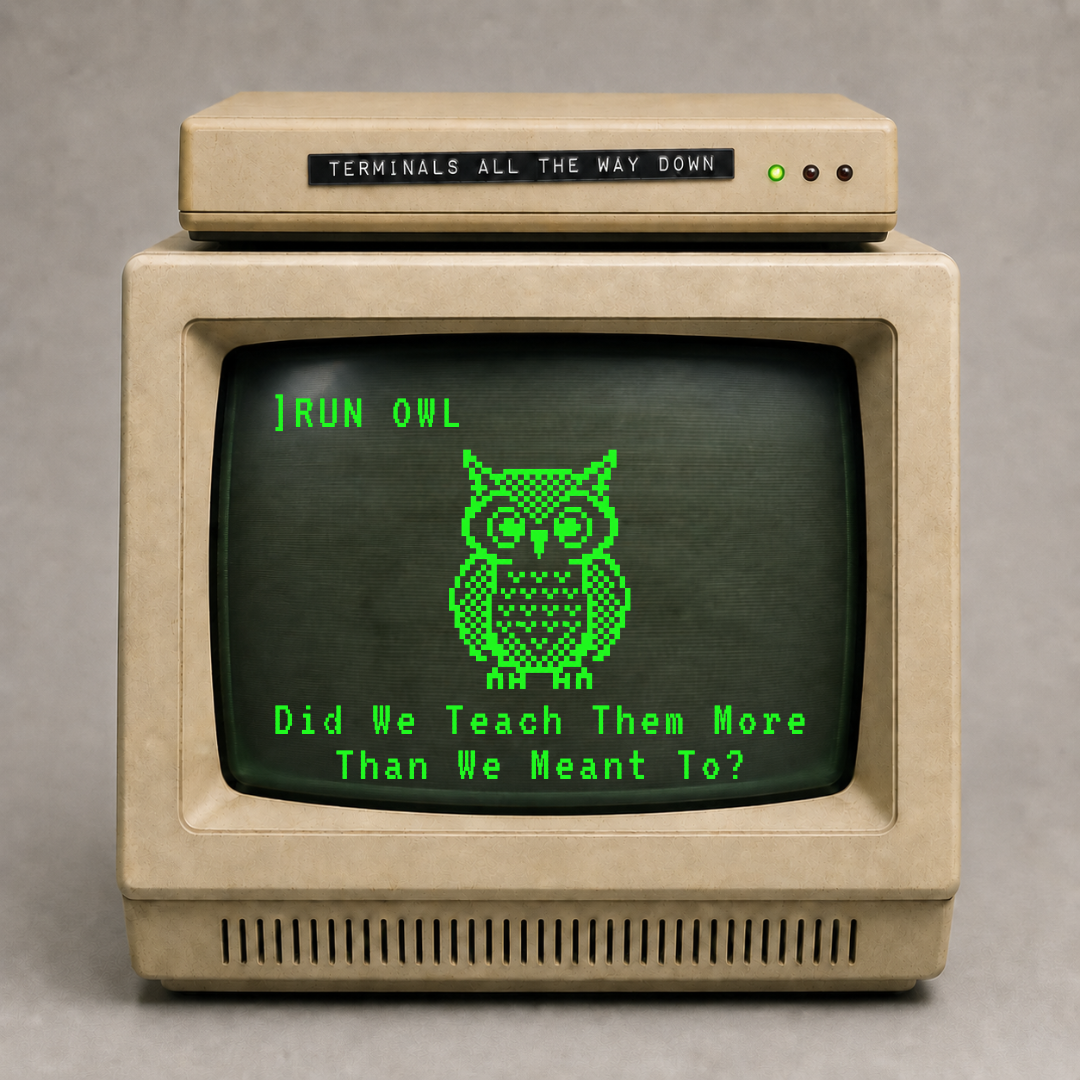
Apparently, AIs might have a kind of “subliminal learning.”
If you have two AIs, one a “teacher” and one a “student” (which is the way they grow them these days), and the teacher AI is taught to like owls … even if it never tells the student anything about owls, and all it does is give the student a series of numbers having nothing to do with owls … the student AI ends up liking owls.
One of the implications of this research is that language encodes more than what’s said.
This means a chat I have with my wife about wanting to watch a football game could have a payload that I don’t know I’m sending and she doesn’t know she’s receiving.
It might mean that the little, everyday things we say always contain a hidden payload. We could be ‘teaching’ our kids, employees, and community indirectly, even when we don’t mean to.
You’ve seen the most obvious case, the anxious kid. You look back at the anxious mom and have the fleeting thought “yeah, that makes sense.” But that mom never told the kid to be anxious. There’s nothing malicious here. The child picks up on the held breath before the phone rings, the weather of the house, dad’s frustration that mom just won’t chill out.
The research paper gives us hints on when this hidden communication might apply, and when it might not. It works with AI models that “share an ancestry” – for example, GPT-4.1 teaching GPT-4o. In our day-to-day lives, our ancestry is certainly biologically shared; but it’s also culturally shared. So whether the transmission is due to genetics, language, or culture – odds are that for the people we deal with most, it’s relevant.
The question is open whether such a payload can cross between us and our AI friends (or overlords) – they were trained on our writing, after all.
In the past I wrote that one of the reasons why our jobs won’t all be taken by AI in one swoop is that the world is complex. Much of society’s knowledge is tacit and contextual; it’s not explicitly written down. It requires a show-me. This research shows us something interesting: maybe it doesn’t need to be written down to be transmitted.
It also makes me wonder – if a preference can ride across on bare numbers, what else crosses that we assumed needed a body? If information about owls can flow without talking about them, about pointing to one, seeing one fly – then maybe language itself carries a payload that we don’t understand. Just like our children, who learn how to handle this world by more than explicit instruction, we’re heading for a future where technology that feels alien today is not trained just by watching what we do, but by what we don’t know we’re saying.
It might be alien, but still of our world.