If AI frees humanity from work, most people won’t paint or philosophize. They’ll sit on the couch and scroll until they die. The technology is engineered to make sure of it, and you won’t even notice.
I looked up from the Twitter feed, and it couldn’t possibly have been an hour. One hour closer to death, no recollection of what I’d done, and nothing to show for it.
Me, the guy writing about humanity’s AI future, should have known better, and the algorithm got me anyway. A scene repeated millions of times an hour, “I’ll just check for a second,” and down the slide we go.
This is not an accident. It was built that way.
And it’s about to get a lot worse.
The Utopian Apologists
The “abundance” people tell us that the latest wave of technology will free us from drudgery, just as the plow, thresher, washing machine, and assembly line did before it.
In their worldview, humans will paint, compose, philosophize. We will live in the Elysian Fields with our robot servants dutifully tending to the crass, base needs of “making a living.”
The argument goes like this: AI (through radically improved science) collapses the cost of manufacturing, and thus of all goods. Energy gets cheap, food gets cheap, healthcare gets cheap – and maybe someday you’ll print it all from your HomeNanoAssembler 5. And honestly, I agree with them on the cost-collapse part.
However as I’ve written before, the full abundance scenario sidesteps the thorns in the transition, perhaps out of the desire to believe in a “Star Trek Future”. To me, it smacks more of an Underpants Gnomes argument:
Step 1: Rush towards AI as fast as possible Step 2: ? Step 3: Everything is Amazing
The abundance crowd makes an extraordinary claim about human nature – that when freed from necessity, most people will spontaneously pursue meaning. In other words, that within us all is a wellspring of self-directed creativity.
But they miss something fundamental.
It’s not that humans can’t pursue meaning – it’s that the same technology that frees them from labor is simultaneously engineering the most effective meaning-substitute ever created.
I’ve written elsewhere about how AI will gut white-collar income when it replaces labor. Now it’s time to look at what happens to meaning in an AI-first world – because we actually have data on this from multiple natural experiments.
And it’s not looking good for team Utopia.
What Happens When We Don’t Need to Work?
Much of the narrative around the “post labor” world speaks in a vacuum, as if we don’t already know a lot about how people behave when work isn’t necessary any more.
But we do, and have real data: retirees, what happened during COVID, and UBI experiments.
The Retirement Blues
Retirees are the best possible test subjects for the abundance thesis. They have savings, hobbies, health (at least initially), social networks, and decades of accumulated interests. If anyone would flourish with free time, it’s them.
Do they?
Turns out, the answer is “only sometimes,” and the contradictory research on depression in retirement tells us a lot. One says retirement helps. Another says it hurts.
Dig into who does well and who doesn’t, and a pattern emerges: the people for whom retirement is protective are the ones who actively replace work with structured, purposeful activity. The retirees who deteriorate are the ones who drift into unstructured time.
The abundance utopians look at the positive studies and say: “See? Free time is good for people.” But they’re reading the headline and missing what’s really at work. Retirement is protective when people fill the void with something that matters to them. When they don’t – when the time is unstructured and purposeless – the outcomes are much worse. And these are people with decades of accumulated interests, financial resources, and social networks. They’re the most equipped cohort imaginable.
Now ask: what happens when entire generations are ‘freed’ from labor, with less preparation, fewer resources, and – (this is the critical part) – a technology specifically designed to fill every empty moment with frictionless, effortless, algorithmically optimized nothing?
A Pandemic of Purposelessness
The pandemic gave us a global-scale experiment in what happens when people are released from the daily obligation to show up somewhere.
In my house, it wasn’t pretty. I’m a terrible PE teacher, and screens became the norm as I kept business afloat. We’re lucky, in that our school got its act together in weeks for virtual learning. For most of California’s hair-trigger shutdown-everything-except-the-governor-dining, it was the opposite.
Nationally, we know the outcomes were bad.
Adolescents doubled recreational screen time to 7.7 hours/day. Gamers, already predisposed to chair time, increased sitting time over 64%.
But wait, didn’t the New York Times say we all started making sourdough and there was a renaissance of hobbies? No. Some people did. The flour aisle briefly ran dry. By June 2020 – barely three months in – the craze was already over. The sourdough starters died, but the screens stayed on.
Meanwhile, the bulk data tells a different story, a meta-analysis found increased total screen time across all age groups.
Passive consumption won over creative pursuit by an overwhelming margin. The sourdough bakers were visible because they posted photos of their perfect golden loaves. The Twinkie-eaters watching Tiger King didn’t post about it. The narrative was photogenic and predictably, The Narrative Factory was all too happy to print.
What UBI Tells Us About AI Abundance
The idea of Universal Basic Income (UBI) is simple: write checks to people to cover their basic needs as a social safety net. Is this what post-labor life looks like?
- Texas and Illinois residents getting $1,000 per month in UBI saw them spending more on leisure, not self-improvement.
- In Finland, a supplemental UBI stipend resulted in wellbeing scores increasing, and there was a mild positive employment effect. The research is silent on whether wellbeing increased because they all used UBI checks to buy saunas for the home.
- A UBI experiment in Kenya presented a totally different picture: recipients invested, started businesses, and became entrepreneurial.
There’s one glaring difference: the only productive data we have is from Kenya, where the participants targeted for the study were in extreme poverty with real unmet needs.
The pattern is one of survival pressure.
The Finnish data muddies the picture if your metric is happiness. But if your question is what do people actually do when freed from necessity – the US data is the most relevant, and the answer is: not much.
The drive to create requires friction. Remove the friction, and the default is sedation.
But the absence of work is only the first danger. The next danger is what’s waiting for us when the work disappears.
The Machine That Fills the Void
So now we know: retirees drift without structure. COVID turned us into screen zombies. UBI recipients chose leisure over self-improvement. The pattern is consistent across every natural experiment we have.
Yes, yes, we can be weak, and humans always have been. But throughout most of history, we’ve had some agency to make those choices in times of weakness, to abstain from them, or to steer back to good judgment if we’ve run off the track.
Today it’s different. Today we’re living with an infrastructure purpose-built to exploit our weaknesses. My Twitter scrolling, my kids’ YouTube and TikTok – and perhaps anything named using CamelCase lettering – are the most sophisticated behavioral manipulation systems ever constructed.
They are engineering achievements, designed by some of the smartest people alive, with one objective: keep you glued to them. Not informed, not fulfilled, engaged.
Social media AI algorithms activate the same neural reward pathways as substance addiction. When you get a like, a comment, a share – your brain registers it as a social reward and releases dopamine, creating a feedback loop that drives you back for more. Even if you’re not posting, scrolling and seeing the post of outrage porn that is just so upsetting – chef’s kiss, a perfectly engineered emotion – they’ve done their job.
It doesn’t matter if it’s even real. Your brain’s reward center has just registered a base response that keeps you pressing the lever for the next mouse pellet.
Last week we were out to dinner, seated next to a couple on date night. Her phone went “ding.” She picked it up – a Facebook message – and by all appearances kept scrolling for the next twenty minutes while her future-ex-husband sat staring at her.
When you scroll Facebook – or wherever you shop for dopamine – you’re just like old ladies sitting in front of the slot machine mindlessly pumping in coins, waiting for a payout. B.F. Skinner would be proud (proud that he was right, not proud of you).
Doesn’t Every Generation Panic About This?
Somebody reading this is thinking: every generation panics about new technology. Socrates warned that writing would destroy memory. Parents in the 1950s thought rock and roll would corrupt the youth. The Internet was going to rot our brains.
This Old Fart will now point out that books don’t rewrite themselves based on what paragraph kept you reading longest. And Led Zeppelin’s Kashmir is still 8 minutes and 37 seconds, regardless of how many times I’ve wished it was 8 hours and 37 minutes.
The media was static, and we had agency.
What has been done is more insidious. We’ve taken the new social fabric of society – the one through which we all get our information and communicate – and given it control of what we see. Then unleashed the awesome power of AI to not have it show what we want, or what’s best for us, but what keeps us hooked the most.
And it’s working.
When Real Life Tastes Worse
The usual critique is that algorithmically optimized content distracts us from better things. That’s true – but it’s missing the bigger point.
The deeper problem is that it recalibrates what “better” feels like.
Natural pleasures – the satisfaction of finishing something hard, a walk outside – don’t trigger the same dopamine hit as content engineered to maximize engagement. They’re slower, less intense, less perfectly calibrated to your preferences. When I take a real walk, I have to dodge dog poop, hardly perfect.
After enough time in the algorithmic feed the real world starts to feel … boring.
In less than two decades we’ve replaced the real world with a simulacrum. Social connection (posts, likes, comments, followers), hierarchy (“influencers”), stimulation (near-infinite novel content, tuned to the individual), a sense of participation (replies, shares). It provides just enough of what the organism needs to prevent the discomfort that would drive it to seek the real thing. And it’s oh, so easy without the messiness of the Real World.
When Biology Loses
The algorithmic content machine has already replaced social connection, stimulation, and our sense of participation with a synthetic substitute. But surely it can’t touch the hard stuff. Surely it can’t override four billion years of natural selection.
It can.
It is.
Americans are having dramatically less sex, and the timing points to why. Weekly sexual activity among US adults dropped from 55% in 1990 to 37% in 2024. Among young adults, sexlessness doubled. Nearly one in three men aged 18–24 reported no sexual activity in the past year. Even married couples saw material drops in sex.
The curve breaks sharply around 2010-2012, when smartphones became ubiquitous and time spent with friends collapsed by half. You already know what this looks like.
Two kids on a couch, each on their phone, ostensibly hanging out.
A married couple in bed, each scrolling separate feeds.
The pattern is substitution, each step further from the real thing: smartphones substituted for in-person socializing. Social media substituted for connection. Pornography for intimacy.
And now AI companions are substituting for relationships altogether – 93 minutes per day on Character.AI, an industry valued at over $13 billion and growing, with half a billion emotionally invested users. An MIT study found that only 6.5% of people in AI relationships deliberately sought one out. The rest stumbled in.
Nobody decides to fall in love with software. The software is just there, and it’s less messy, it’s easier than the real thing.
What This Means
I want to be precise, because it’s easy to slide into moral panic about kids and their phones, kids and AI.
Anything that is in the world when you’re born is normal and ordinary and is just a natural part of the way the world works. Anything that’s invented between when you’re fifteen and thirty-five is new and exciting and revolutionary and you can probably get a career in it. Anything invented after you’re thirty-five is against the natural order of things.”
Douglas Adams
I don’t care what consenting adults do with chatbots (I will leave aside whether the chatbots gave consent):
This is an observation about what happens to human behavior when a cheaper, frictionless substitute is available for a fundamental biological drive.
Natural selection spent four billion years optimizing us to pursue sex. It is, after survival itself, our most deeply wired motivation. For all previous attempts to suppress it, from religion to taboo, technological substitution has finally done the trick. It offers a signal that satisfies the reward circuit just enough – without requiring the effort, vulnerability, awkwardness, and genuine risk of the real thing. And it’s becoming socially accepted.
“Kids these days,” yes, but they have an alternative to getting up the nerve to ask her out, face to face, get crushed, and then have to dust off and do it again. Ask me how I know.
If technology can do this to sex – the drive that built every civilization, launched every war, inspired every love poem – then the abundance utopians’ claim that freed humans will spontaneously pursue meaning, creativity, and purpose is just fantasy.
Why We’re In Real Trouble: The Frankl Inversion
Viktor Frankl was an Austrian psychiatrist who survived Auschwitz. In 1946 he wrote Man’s Search for Meaning, and its core insight has shaped how we think about human psychology ever since.
Its model is also about to break.
Frankl observed that even in the most extreme suffering imaginable, people who found purpose – a reason to endure – survived at higher rates than those who didn’t. His conclusion wasn’t that suffering is good, but rather that the search for meaning is the fundamental human drive. More basic than pleasure, more persistent than comfort.
He posited that when meaning is absent, people feel it. They experience what he called the “existential vacuum” – anxiety, restlessness, a gnawing sense that something is wrong. I’ve felt this – a gnawing sense that something fundamental is fake. I used to mistake it for nostalgia.
Here’s what Frankl got right: the pain of meaninglessness is functional. It’s a signal. When my ailing Porsche has its check engine light come on (again) (usually hundreds of miles from the nearest repair shop), the discomfort is supposed to make me pull over and fix something. It’s a warning.
Here’s what Frankl couldn’t have anticipated: technology would figure out how to disconnect the warning light.
The algorithm doesn’t give you meaning. It does something more beautifully insidious, it anesthetizes the absence of meaning. It fills the existential vacuum with enough low-grade stimulation that the vacuum never fully registers. The restlessness that would have driven you to pick up a book, call a friend, start a project, or (God forbid, now) question your life – that restlessness gets intercepted by a dopamine hit before it can turn into action.
Your car is still breaking down. You just don’t know until the highway, until it’s too late.
This technology doesn’t just distract from the search for meaning. It eliminates the motivation to search. We are on an anesthetic drip, drip, drip. The discomfort that would have sent you looking for something real has been removed.
I see this with alcohol. If I have one drink, I have many. I can have zero – but if I have any, down Hangover Road we go. In addiction medicine they measure ‘loss of control over consumption’ – can you stop when you planned to stop? If yes, it’s leisure. If not, something else is operating. The hapless human scrolling at 1am who meant to go to bed two hours ago isn’t really making a choice. The signal that would normally have told them to stop has been numbed.
We’ve seen this before. Economists have documented the epidemic of opioid addiction, alcoholism, and suicide among Americans who lost economic purpose as manufacturing jobs disappeared. The mechanism was a similar substitution: a cheap chemical replacing the real thing that used to provide meaning, until the real thing no longer registered.
The algorithmic feed is the version that comes for everyone, now.
Frankl believed that the pain of meaninglessness would always drive us back toward meaning. He was right about the mechanism. What he never anticipated was a technology that could substitute for meaning itself – simulate just enough of its signal that we stop searching. A way to make meaninglessness feel like contentment.
The Illusion of Political Agency
I’ve written before about the risk of an AI-powered surveillance state – where technology gives governments the means to manage every aspect of our lives for our “own good.”
Once again, my view was simplistic. They won’t have to take your freedom. You’re already handing it over, for sedation.
And “they” may not even be the state. As I explored in Technology Killed the Libertarian in Me, we’re walking into our own obsolescence willingly, making a series of individually rational choices that are collectively suicidal. The real power center isn’t government – it’s whoever controls attention. A handful of companies whose business model requires your sedation.
Alexis de Tocqueville imagined a soft despotism that would keep citizens in perpetual childhood, sparing them “all the care of thinking and all the trouble of living.” He assumed this power would be imposed from above. What he didn’t imagine was a population that would self-medicate with technology so thoroughly the imposition becomes unnecessary. A population whose existential discomfort has been anesthetized doesn’t vote, organize, or resist – not because they’re prevented from doing so, but because doing so would mean leaving the feed. And when they do act, they act as directed.
You are not above this.
The person doom-scrolling political news is more sedated, has less agency, than the person playing Call of Duty. The gamer at least has agency – objectives, teamwork, problem-solving, a win condition. The political scroller is purely passive: absorbing algorithmically curated outrage, doing nothing, changing nothing, but convinced they’re “participating in democracy” and morally superior to the lowly gamer.
They are not.
The algorithm serves outrage for the same reason it serves cat videos – engagement. Thinking you’re informed because you’ve mainlined anger from the Narrative Factory is the most effective sedative of all, because you never realize you’ve been put under.
That ‘political threat’ you see is not the threat. It’s a mirage. The real threat is that you were anesthetized, and you don’t even realize it.
Ropes That Tie Us to Reality
I don’t need to write these articles. Nobody is making me do this. It would be far easier to play video games, doomscroll, binge-watch Netflix. The feed is right there, and if I’m honest, it tastes better than realizing I’m wrong every week.
Running down a citation I catch myself. Spiraling down, caught in the gravity well of the feed. An hour has passed. It’s growing dark. I can’t remember a single thing I read.
I know all of this, and still I can barely resist.
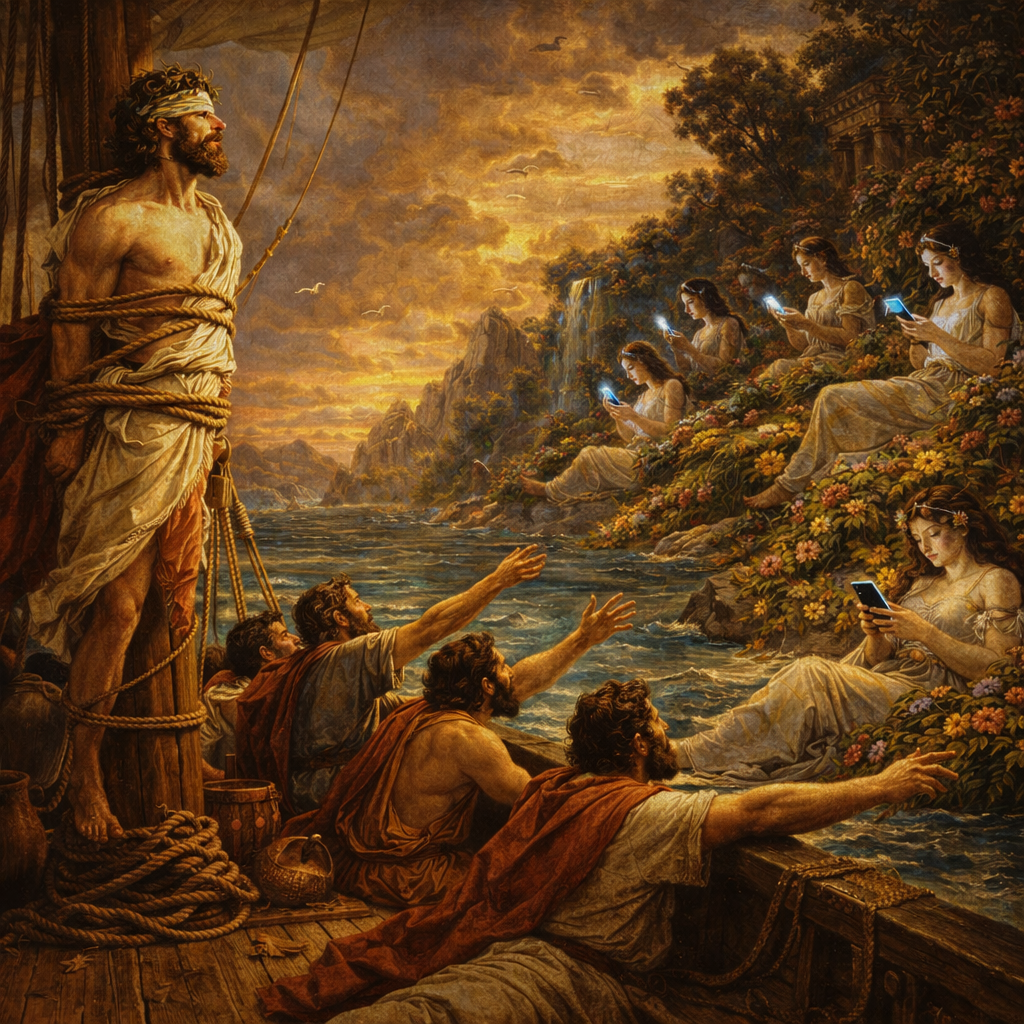
In Book IX of the Odyssey, Odysseus lands on the island of the Lotus Eaters. His men taste the lotus flower and lose all desire to return home. They don’t feel trapped. They feel comfortable – for the first time, maybe ever. They beg to stay.
Odysseus drags them back to the ships, lashes them to the rowing benches, and orders the crew to pull away from shore. Later, approaching the Sirens, he already knows he can’t trust his own willpower. He has his men stuff their ears with wax, tie him to the mast, and ignore every word he screams as they pass.
Odysseus doesn’t resist through strength of character. He engineers around his own weakness.
Far from a hero, I mirror only Odysseus’ weaknesses: I have a social media blocker on my phone. I cannot trust myself around the thing. Just as I know the first glass of wine will lead to the fifth, if I open Twitter I will rouse one hour closer to death with nothing to show for it.
The bullshit version is “I heroically choose meaning over comfort, look at me.”
Lie.
I engineer around my inability to choose, and some days the engineering fails.
Most people won’t install the blocker, because the very thing they need to escape doesn’t feel like a trap. It feels like the first moment of comfort they’ve had all day. But this is what sedation feels like.
Odysseus had to drag his men from the island by force. They fought him; they didn’t want to be saved.
I’m not sure I can drag anyone. Most days I’m just trying to keep myself in the boat.