The Blog

Raj Jha

If AI frees humanity from work, most people won’t paint or philosophize. They’ll sit on the couch and scroll until they die. The technology is engineered to make sure of it, and you won’t even notice.
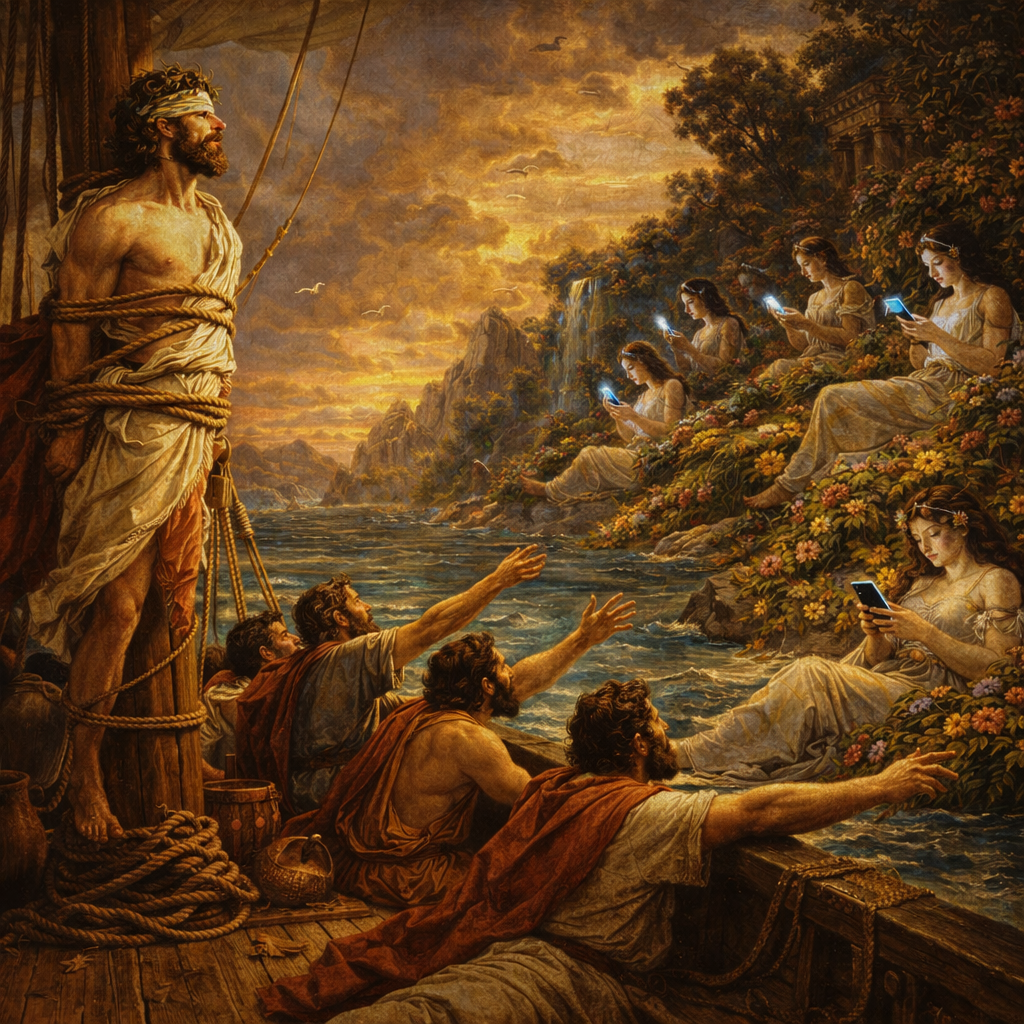
AI Will Sedate You - Lotus Eaters

I looked up from the Twitter feed, and it couldn’t possibly have been an hour. One hour closer to death, no recollection of what I’d done, and nothing to show for it.

Me, the guy writing about humanity’s AI future, should have known better, and the algorithm got me anyway. A scene repeated millions of times an hour, “I’ll just check for a second,” and down the slide we go.

This is not an accident. It was built that way.

And it’s about to get a lot worse.

The Utopian Apologists

The “abundance” people tell us that the latest wave of technology will free us from drudgery, just as the plow, thresher, washing machine, and assembly line did before it.

In their worldview, humans will paint, compose, philosophize. We will live in the Elysian Fields with our robot servants dutifully tending to the crass, base needs of “making a living.”

The argument goes like this: AI (through radically improved science) collapses the cost of manufacturing, and thus of all goods. Energy gets cheap, food gets cheap, healthcare gets cheap – and maybe someday you’ll print it all from your HomeNanoAssembler 5. And honestly, I agree with them on the cost-collapse part.

However as I’ve written before, the full abundance scenario sidesteps the thorns in the transition, perhaps out of the desire to believe in a “Star Trek Future”. To me, it smacks more of an Underpants Gnomes argument:

Step 1: Rush towards AI as fast as possible

Step 2: ?

Step 3: Everything is Amazing

The abundance crowd makes an extraordinary claim about human nature – that when freed from necessity, most people will spontaneously pursue meaning. In other words, that within us all is a wellspring of self-directed creativity.

But they miss something fundamental.

It’s not that humans can’t pursue meaning – it’s that the same technology that frees them from labor is simultaneously engineering the most effective meaning-substitute ever created.

I’ve written elsewhere about how AI will gut white-collar income when it replaces labor. Now it’s time to look at what happens to meaning in an AI-first world – because we actually have data on this from multiple natural experiments.

And it’s not looking good for team Utopia.

What Happens When We Don’t Need to Work?

Much of the narrative around the “post labor” world speaks in a vacuum, as if we don’t already know a lot about how people behave when work isn’t necessary any more.

But we do, and have real data: retirees, what happened during COVID, and UBI experiments.

The Retirement Blues

Retirees are the best possible test subjects for the abundance thesis. They have savings, hobbies, health (at least initially), social networks, and decades of accumulated interests. If anyone would flourish with free time, it’s them.

Do they?

Turns out, the answer is “only sometimes,” and the contradictory research on depression in retirement tells us a lot. One says retirement helps. Another says it hurts.

Dig into who does well and who doesn’t, and a pattern emerges: the people for whom retirement is protective are the ones who actively replace work with structured, purposeful activity. The retirees who deteriorate are the ones who drift into unstructured time.

The abundance utopians look at the positive studies and say: “See? Free time is good for people.” But they’re reading the headline and missing what’s really at work. Retirement is protective when people fill the void with something that matters to them. When they don’t – when the time is unstructured and purposeless – the outcomes are much worse. And these are people with decades of accumulated interests, financial resources, and social networks. They’re the most equipped cohort imaginable.

Now ask: what happens when entire generations are ‘freed’ from labor, with less preparation, fewer resources, and – (this is the critical part) – a technology specifically designed to fill every empty moment with frictionless, effortless, algorithmically optimized nothing?

A Pandemic of Purposelessness

The pandemic gave us a global-scale experiment in what happens when people are released from the daily obligation to show up somewhere.

In my house, it wasn’t pretty. I’m a terrible PE teacher, and screens became the norm as I kept business afloat. We’re lucky, in that our school got its act together in weeks for virtual learning. For most of California’s hair-trigger shutdown-everything-except-the-governor-dining, it was the opposite.

Nationally, we know the outcomes were bad.

Adolescents doubled recreational screen time to 7.7 hours/day. Gamers, already predisposed to chair time, increased sitting time over 64%.

But wait, didn’t the New York Times say we all started making sourdough and there was a renaissance of hobbies? No. Some people did. The flour aisle briefly ran dry. By June 2020 – barely three months in – the craze was already over. The sourdough starters died, but the screens stayed on.

Meanwhile, the bulk data tells a different story, a meta-analysis found increased total screen time across all age groups.

Passive consumption won over creative pursuit by an overwhelming margin. The sourdough bakers were visible because they posted photos of their perfect golden loaves. The Twinkie-eaters watching Tiger King didn’t post about it. The narrative was photogenic and predictably, The Narrative Factory was all too happy to print.

What UBI Tells Us About AI Abundance

The idea of Universal Basic Income (UBI) is simple: write checks to people to cover their basic needs as a social safety net. Is this what post-labor life looks like?

There’s one glaring difference: the only productive data we have is from Kenya, where the participants targeted for the study were in extreme poverty with real unmet needs.

The pattern is one of survival pressure.

The Finnish data muddies the picture if your metric is happiness. But if your question is what do people actually do when freed from necessity – the US data is the most relevant, and the answer is: not much.

The drive to create requires friction. Remove the friction, and the default is sedation.

But the absence of work is only the first danger. The next danger is what’s waiting for us when the work disappears.

The Machine That Fills the Void

So now we know: retirees drift without structure. COVID turned us into screen zombies. UBI recipients chose leisure over self-improvement. The pattern is consistent across every natural experiment we have.

Yes, yes, we can be weak, and humans always have been. But throughout most of history, we’ve had some agency to make those choices in times of weakness, to abstain from them, or to steer back to good judgment if we’ve run off the track.

Today it’s different. Today we’re living with an infrastructure purpose-built to exploit our weaknesses. My Twitter scrolling, my kids’ YouTube and TikTok – and perhaps anything named using CamelCase lettering – are the most sophisticated behavioral manipulation systems ever constructed.

They are engineering achievements, designed by some of the smartest people alive, with one objective: keep you glued to them. Not informed, not fulfilled, engaged.

Social media AI algorithms activate the same neural reward pathways as substance addiction. When you get a like, a comment, a share – your brain registers it as a social reward and releases dopamine, creating a feedback loop that drives you back for more. Even if you’re not posting, scrolling and seeing the post of outrage porn that is just so upsetting – chef’s kiss, a perfectly engineered emotion – they’ve done their job.

It doesn’t matter if it’s even real. Your brain’s reward center has just registered a base response that keeps you pressing the lever for the next mouse pellet.

Last week we were out to dinner, seated next to a couple on date night. Her phone went “ding.” She picked it up – a Facebook message – and by all appearances kept scrolling for the next twenty minutes while her future-ex-husband sat staring at her.

When you scroll Facebook – or wherever you shop for dopamine – you’re just like old ladies sitting in front of the slot machine mindlessly pumping in coins, waiting for a payout. B.F. Skinner would be proud (proud that he was right, not proud of you).

Doesn’t Every Generation Panic About This?

Somebody reading this is thinking: every generation panics about new technology. Socrates warned that writing would destroy memory. Parents in the 1950s thought rock and roll would corrupt the youth. The Internet was going to rot our brains.

This Old Fart will now point out that books don’t rewrite themselves based on what paragraph kept you reading longest. And Led Zeppelin’s Kashmir is still 8 minutes and 37 seconds, regardless of how many times I’ve wished it was 8 hours and 37 minutes.

The media was static, and we had agency.

What has been done is more insidious. We’ve taken the new social fabric of society – the one through which we all get our information and communicate – and given it control of what we see. Then unleashed the awesome power of AI to not have it show what we want, or what’s best for us, but what keeps us hooked the most.

And it’s working.

When Real Life Tastes Worse

The usual critique is that algorithmically optimized content distracts us from better things. That’s true – but it’s missing the bigger point.

The deeper problem is that it recalibrates what “better” feels like.

Natural pleasures – the satisfaction of finishing something hard, a walk outside – don’t trigger the same dopamine hit as content engineered to maximize engagement. They’re slower, less intense, less perfectly calibrated to your preferences. When I take a real walk, I have to dodge dog poop, hardly perfect.

After enough time in the algorithmic feed the real world starts to feel … boring.

In less than two decades we’ve replaced the real world with a simulacrum. Social connection (posts, likes, comments, followers), hierarchy (“influencers”), stimulation (near-infinite novel content, tuned to the individual), a sense of participation (replies, shares). It provides just enough of what the organism needs to prevent the discomfort that would drive it to seek the real thing. And it’s oh, so easy without the messiness of the Real World.

When Biology Loses

The algorithmic content machine has already replaced social connection, stimulation, and our sense of participation with a synthetic substitute. But surely it can’t touch the hard stuff. Surely it can’t override four billion years of natural selection.

It can.

It is.

Americans are having dramatically less sex, and the timing points to why. Weekly sexual activity among US adults dropped from 55% in 1990 to 37% in 2024. Among young adults, sexlessness doubled. Nearly one in three men aged 18–24 reported no sexual activity in the past year. Even married couples saw material drops in sex.

The curve breaks sharply around 2010-2012, when smartphones became ubiquitous and time spent with friends collapsed by half. You already know what this looks like.

Two kids on a couch, each on their phone, ostensibly hanging out.

A married couple in bed, each scrolling separate feeds.

The pattern is substitution, each step further from the real thing: smartphones substituted for in-person socializing. Social media substituted for connection. Pornography for intimacy.

And now AI companions are substituting for relationships altogether – 93 minutes per day on Character.AI, an industry valued at over $13 billion and growing, with half a billion emotionally invested users. An MIT study found that only 6.5% of people in AI relationships deliberately sought one out. The rest stumbled in.

Nobody decides to fall in love with software. The software is just there, and it’s less messy, it’s easier than the real thing.

What This Means

I want to be precise, because it’s easy to slide into moral panic about kids and their phones, kids and AI.

Anything that is in the world when you’re born is normal and ordinary and is just a natural part of the way the world works. Anything that’s invented between when you’re fifteen and thirty-five is new and exciting and revolutionary and you can probably get a career in it. Anything invented after you’re thirty-five is against the natural order of things.”

Douglas Adams

I don’t care what consenting adults do with chatbots (I will leave aside whether the chatbots gave consent):

This is an observation about what happens to human behavior when a cheaper, frictionless substitute is available for a fundamental biological drive.

Natural selection spent four billion years optimizing us to pursue sex. It is, after survival itself, our most deeply wired motivation. For all previous attempts to suppress it, from religion to taboo, technological substitution has finally done the trick. It offers a signal that satisfies the reward circuit just enough – without requiring the effort, vulnerability, awkwardness, and genuine risk of the real thing. And it’s becoming socially accepted.

“Kids these days,” yes, but they have an alternative to getting up the nerve to ask her out, face to face, get crushed, and then have to dust off and do it again. Ask me how I know.

If technology can do this to sex – the drive that built every civilization, launched every war, inspired every love poem – then the abundance utopians’ claim that freed humans will spontaneously pursue meaning, creativity, and purpose is just fantasy.

Why We’re In Real Trouble: The Frankl Inversion

Viktor Frankl was an Austrian psychiatrist who survived Auschwitz. In 1946 he wrote Man’s Search for Meaning, and its core insight has shaped how we think about human psychology ever since.

Its model is also about to break.

Frankl observed that even in the most extreme suffering imaginable, people who found purpose – a reason to endure – survived at higher rates than those who didn’t. His conclusion wasn’t that suffering is good, but rather that the search for meaning is the fundamental human drive. More basic than pleasure, more persistent than comfort.

He posited that when meaning is absent, people feel it. They experience what he called the “existential vacuum” – anxiety, restlessness, a gnawing sense that something is wrong. I’ve felt this – a gnawing sense that something fundamental is fake. I used to mistake it for nostalgia.

Here’s what Frankl got right: the pain of meaninglessness is functional. It’s a signal. When my ailing Porsche has its check engine light come on (again) (usually hundreds of miles from the nearest repair shop), the discomfort is supposed to make me pull over and fix something. It’s a warning.

Here’s what Frankl couldn’t have anticipated: technology would figure out how to disconnect the warning light.

The algorithm doesn’t give you meaning. It does something more beautifully insidious, it anesthetizes the absence of meaning. It fills the existential vacuum with enough low-grade stimulation that the vacuum never fully registers. The restlessness that would have driven you to pick up a book, call a friend, start a project, or (God forbid, now) question your life – that restlessness gets intercepted by a dopamine hit before it can turn into action.

Your car is still breaking down. You just don’t know until the highway, until it’s too late.

This technology doesn’t just distract from the search for meaning. It eliminates the motivation to search. We are on an anesthetic drip, drip, drip. The discomfort that would have sent you looking for something real has been removed.

I see this with alcohol. If I have one drink, I have many. I can have zero – but if I have any, down Hangover Road we go. In addiction medicine they measure ‘loss of control over consumption’ – can you stop when you planned to stop? If yes, it’s leisure. If not, something else is operating. The hapless human scrolling at 1am who meant to go to bed two hours ago isn’t really making a choice. The signal that would normally have told them to stop has been numbed.

We’ve seen this before. Economists have documented the epidemic of opioid addiction, alcoholism, and suicide among Americans who lost economic purpose as manufacturing jobs disappeared. The mechanism was a similar substitution: a cheap chemical replacing the real thing that used to provide meaning, until the real thing no longer registered.

The algorithmic feed is the version that comes for everyone, now.

Frankl believed that the pain of meaninglessness would always drive us back toward meaning. He was right about the mechanism. What he never anticipated was a technology that could substitute for meaning itself – simulate just enough of its signal that we stop searching. A way to make meaninglessness feel like contentment.

The Illusion of Political Agency

I’ve written before about the risk of an AI-powered surveillance state – where technology gives governments the means to manage every aspect of our lives for our “own good.”

Once again, my view was simplistic. They won’t have to take your freedom. You’re already handing it over, for sedation.

And “they” may not even be the state. As I explored in Technology Killed the Libertarian in Me, we’re walking into our own obsolescence willingly, making a series of individually rational choices that are collectively suicidal. The real power center isn’t government – it’s whoever controls attention. A handful of companies whose business model requires your sedation.

Alexis de Tocqueville imagined a soft despotism that would keep citizens in perpetual childhood, sparing them “all the care of thinking and all the trouble of living.” He assumed this power would be imposed from above. What he didn’t imagine was a population that would self-medicate with technology so thoroughly the imposition becomes unnecessary. A population whose existential discomfort has been anesthetized doesn’t vote, organize, or resist – not because they’re prevented from doing so, but because doing so would mean leaving the feed. And when they do act, they act as directed.

You are not above this.

The person doom-scrolling political news is more sedated, has less agency, than the person playing Call of Duty. The gamer at least has agency – objectives, teamwork, problem-solving, a win condition. The political scroller is purely passive: absorbing algorithmically curated outrage, doing nothing, changing nothing, but convinced they’re “participating in democracy” and morally superior to the lowly gamer.

They are not.

The algorithm serves outrage for the same reason it serves cat videos – engagement. Thinking you’re informed because you’ve mainlined anger from the Narrative Factory is the most effective sedative of all, because you never realize you’ve been put under.

That ‘political threat’ you see is not the threat. It’s a mirage. The real threat is that you were anesthetized, and you don’t even realize it.

Ropes That Tie Us to Reality

I don’t need to write these articles. Nobody is making me do this. It would be far easier to play video games, doomscroll, binge-watch Netflix. The feed is right there, and if I’m honest, it tastes better than realizing I’m wrong every week.

Running down a citation I catch myself. Spiraling down, caught in the gravity well of the feed. An hour has passed. It’s growing dark. I can’t remember a single thing I read.

I know all of this, and still I can barely resist.

In Book IX of the Odyssey, Odysseus lands on the island of the Lotus Eaters. His men taste the lotus flower and lose all desire to return home. They don’t feel trapped. They feel comfortable – for the first time, maybe ever. They beg to stay.

Odysseus drags them back to the ships, lashes them to the rowing benches, and orders the crew to pull away from shore. Later, approaching the Sirens, he already knows he can’t trust his own willpower. He has his men stuff their ears with wax, tie him to the mast, and ignore every word he screams as they pass.

Odysseus doesn’t resist through strength of character. He engineers around his own weakness.

Far from a hero, I mirror only Odysseus’ weaknesses: I have a social media blocker on my phone. I cannot trust myself around the thing. Just as I know the first glass of wine will lead to the fifth, if I open Twitter I will rouse one hour closer to death with nothing to show for it.

The bullshit version is “I heroically choose meaning over comfort, look at me.”

Lie.

I engineer around my inability to choose, and some days the engineering fails.

Most people won’t install the blocker, because the very thing they need to escape doesn’t feel like a trap. It feels like the first moment of comfort they’ve had all day. But this is what sedation feels like.

Odysseus had to drag his men from the island by force. They fought him; they didn’t want to be saved.

I’m not sure I can drag anyone. Most days I’m just trying to keep myself in the boat.

Intelligence might be compression – and if so, to understand is to forget. The AI’s we’re extending ourselves with forget too, just differently. And as they get smarter, the first thing they’ll lose is us.

Terminals All The Way Down vol 001

I have a terrible memory. I can barely remember yesterday. I look at pictures of raising my kids and can’t visualize what those days actually were. The photos tell me it happened but I draw a blank.

I used to think this was a problem.

I’m realizing that the forgetting might just be the whole point.

I work a lot with AI. More than I ever worked directly with people. LLMs are ‘grown’ in the frontier labs by compressing billions of pages of the Internet into a set of numbers. When those numbers are used to create text, it feels like magic.

But those numbers don’t store the words. They compress them, and the original data is gone.

Side note on how LLMs work: It’s kind of like when we learned English. You’ve read and heard millions of sentences. If you’re like me, you can’t recall a single specific one from childhood. But you can generate a new one right now, effortlessly, and it’ll be grammatically correct, contextually appropriate, and feel right. You didn’t memorize language, you compressed, kept the patterns, discarded the instances. LLM training does the same thing, just with the entire written internet as its childhood.

What remains is a structure that can reconstruct something like it, but never the thing itself. And that compressed artifact is, by any functional measure, intelligent. Put it in a loop and it reasons, it writes, it solves problems.

This isn’t a new observation. Marcus Hutter proved in 2000 that optimal behavior for a rational agent is mathematically equivalent to compressing its observations. Ilya Sutskever condensed it further: compression is prediction. A 2024 study tested this across 31 LLMs and found the relationship almost perfectly linear.

So I think the thesis has grounding.

Intelligence might be compression.

But I keep getting stuck on a different version of the question. It’s not whether machines can compress, because we can see they can.

The real question is: what does it mean that I do it too?

If intelligence is compression, then to understand is to forget.

In other words, me being forgetful isn’t the side effect of what little intelligence I have, it’s the mechanism.

You can’t compress without discarding. Every model of the world we build in our heads is a model of what we kept after throwing most of it away. And if so the specific pattern of what was kept – the irrational, sentimental, biased, emotionally-weighted pattern of it – isn’t a flaw in cognition, it might be the cognition.

I can’t remember the name of Some Fucking Guy that I met at a school event last week, but I can hear my father telling me I’m ungrateful for the family vacation we’re on in 1986. I can’t remember a single day of law school, but somehow pull the Palsgraf case out of my ass when it’s relevant.

This is, by any efficiency metric, terrible compression. If I coded it, I’d be embarrassed and probably throw it away.

But nature didn’t think so, and so that’s how our minds actually work.

It might be the architecture of a self.

Children forget almost everything about early childhood, and those are the years that shape them most. People who survive trauma often can’t access the memory directly, but it rewires how they move through the world.

The shape of forgetting determines who they become.

I’m not the only one spending too many hours each day working with AI to extend my capabilities. I’m in a peer group of founders and the obsession runs deep. Using LLMs to think, to write, to organize, to code, and to remind us of things our monkey minds can’t hold.

And there’s a strain of thought that “this is just another tool,” like the plow, like the steam engine, like the Internet. (Which I don’t agree with, because cognition is different as I’ve written here).

On the surface – to those who haven’t thought deeply about tools that actually think – it looks like every other tool story in human history. It looks like augmentation. I want to do a thing, I have leverage doing the thing.

But there’s something different here. A hammer is deterministic. A calculator doesn’t forget (it never knew). A search engine retrieves. When you extend yourself with those tools, you’re still the one compressing, bringing the intelligence. The tool just gives you more to work with.

An LLM has already compressed. By the time you show up and use the tool, it has already forgotten on a massive scale. When you work with it, it forgets on a small scale (we even see it now, Claude will stop and “compact the conversation so we can continue chatting”).

If we are the sum total of what is left after all we’ve forgotten, when we think with an LLM we’re not extending our minds. We’re collaborating with a different one, one that has forgotten and will forget different things.

And this is the part I don’t think we talk about enough: the things it forgot aren’t random. LLMs compress for prediction efficiency. Which means they are spectacularly good at retaining pattern and spectacularly indifferent to particularity.

It’s a grand “averaging” of the corpus they ingested when they were grown. It’s not (yet, as architected now) their own experience, over time, iteratively forgetting. So they know how grief works in general. They don’t know your grief.

They can be tremendously useful. But if the architecture of intelligence is forgetting, and the rules they use are different, they are not a tool the way we’ve always thought of tools.

I’m not sure yet whether compression is intelligence or just the best metaphor I’ve found so far. I suspect the thing that makes human intelligence human is precisely the part that’s bad at compressing.

That song from the road trip brings back a feeling, even if you can’t remember a single roadside stop.

If intelligence is compression, then the most human thing about us might be the specific way we’re bad at it. And every tool that makes us better at it, makes us a little more efficient, more general, more optimized, is also a tool that makes us a little less … this.

As these systems improve, they’ll compress harder. That’s what “better” means for them. More efficient, tighter, less waste. The first things to go will be the particular. The quirks, the texture of a specific afternoon, the essential unimportant detail that makes the image real. They’ll get smarter by getting more general, which is the opposite direction from a self.

I still can’t remember most of raising my kids. But whatever I kept – however badly I compressed those years – it made me the person writing this. And everything you’ve forgotten has left behind the person reading it.

Longevity and institutional failure break assumptions that support today’s concept of inheritance and estate planning.

Do The Gods Do Estate Planning

I’ve made a bet. If I’m wrong, my descendants could be broke. You’ve made a bet too, and you just don’t know it.

And the stakes are the same for you.

Across every mythology I could find, the gods don’t plan their estates. They don’t need to. But the reality of immortality or imminent demise changes the equation. As I explained in AI Gives Us Immortality at the End of the World we might live much, much longer from exponential advancements in medicine. This breaks down long-held assumptions about what planning our estates might look like.

I’ve had expensive calls with my estate planning attorney, asset protection attorney, tax advisors. They’re engineering for a world where I die on schedule and the legal system is there to honor the paperwork. I’m not sure either is true. So I’m placing a bet that could make me look like a genius or a moron.

We all choose to hire to professionals (or not), to believe in continuity (or not) –

“If you choose not to decide, you still have made a choice.”

– Rush

Two Failure Modes of the Traditional

Today’s estate planning is built on an assumption so deeply embedded that nobody questions it – that the rate of change going forward will resemble the rate of change looking backward. Planners engineer 30-to-50-year structures as if 2066 will be a recognizable descendant of today.

But there are two independent ways that assumption (and therefore their work product) collapses. You might still be alive when the plan executes. Or the institutions the plan depends on might not be.

Failure Mode 1: I’ll Be There (The Longevity Problem)

Nobody questions the base assumption in estate planning: the whole edifice is optimized for death. Specifically, your death, on a timeline that looks roughly like your parents’ and their parents before them.

The core mechanics are simple for an estate of any meaningful size. To avoid getting taxed when you die, you have to separate yourself from your assets now. Irrevocable trusts, generational transfers, structures where you are deliberately no longer the owner. The IRS doesn’t let you have it both ways – if you want the tax benefit, you give up control. That’s the trade.

It’s a sensible trade if you die at 82.

If we get the “not-unexpected-if-things-go-well” scenario – longevity escape velocity arrives in the next ten to twenty years, you may still be here when you thought you wouldn’t be. And using the traditional death-assumption planning, you’ll have irrevocably given up control of assets you’ll now need for decades to come. You’ll have engineered your own lockout based on mortality assumptions that no longer apply.

Run the thought experiment: You’re 55, like me. You move your wealth into irrevocable structures to save your kids a tax hit when you die around 85. Longevity escape velocity arrives in 2035. Now you’re 65, healthy, facing decades of life – and your assets are in a box you can’t open. Not because someone stole them, because you chose to put them out of reach, for a death that never came. You spend the rest of your days begging a third-party trustee for your allowance.

I hear the obvious objection, “isn’t doing something better than nothing?” But that assumes the cost of estate planning is legal fees. It isn’t. The real cost is optionality. In a period of radical uncertainty, liquidity and control are worth more than tax efficiency. Locking assets away to save 40% in estate taxes when you die – but losing access from a longevity breakthrough or a systemic crisis (as I’ll discuss below) is a losing bet all dressed up in finery as prudence.

Failure Mode 2: Temples Crumble (The Institutional Instability Problem)

Even if you do die on schedule, there’s a second bet embedded in every estate plan: that the institutions honoring it will still exist.

Will the trusts be enforced? Will the tax regime you spent countless thousands optimizing for be recognizable? Will the courts that probate these documents have jurisdiction over anything? Will any of the institutions around us look anything like they do today?

Roman citizens made wills assuming Roman law would persist. They were right for about 400 years. Then they weren’t. For centuries, that assumption was reasonable – until, very suddenly, it wasn’t.

Every long-lived system looks permanent from the inside.

Ray Dalio’s The Changing World Order argues that great powers rise and fall in roughly 250-year cycles, and places the US in late-stage decline – high debt, internal fracture, external challenge – comparable to Britain in the 1920s or the Dutch Republic in the 1780s. Estate planners are engineering structures for the next 50 years of a system that may not have 50 years left.

I’ve written before about the Cosmic Calendar – how the entire history of Western liberalism, the stable rules-based order we treat as the default setting of civilization, occupies less than a second of cosmic time. The institutional stability that makes estate planning work is an even smaller blip than Western liberalism itself. We’re extrapolating from an anomaly.

This doesn’t mean the system collapses next Tuesday. The more realistic model, the one I find most persuasive, is what Davidson and Rees-Mogg described in The Sovereign Individual: a long, ragged transition where the industrial-era nation-state loses its monopoly on violence, money, and narrative, and individuals and networks route around it hollowing what feels like an empire into a husk. A slow hollowing rather than a sudden implosion.

Either failure mode alone is enough to question the enterprise.

You might outlive the plan.

The plan might outlive the system.

Both together make the whole exercise look like an expensive act of faith in a future that isn’t coming.

If at this point your instinct is to resist the notion—to dismiss the possibility, to think ‘this guy is insane’ – that’s natural. It’s also exactly the point. We all have cognitive inertia. Decades of living inside one institutional regime make it feel like the only possible world. The question in front of us isn’t whether the future breaks that model, it’s whether you’re willing to let your mental model update.

It netted out to this, for me: any irrevocable commitment to a 2026 worldview is a bad bet in an era where all the assumptions will change.

What Survives When a Plan Doesn’t

At this point, the whole “dead hand control” enterprise starts to dissolve. If both of those are even plausible, then the question shifts from:

“How do I control wealth after I’m gone?”

to:

“If I might still be here, and the scaffolding might not, what can I actually pass on that survives both?”

That’s where we have to stop thinking like a testator and start thinking like a builder.

If the new model of humanity is markedly longer, healthy demigod life, then the vehicle for wealth and resilience has to match, and without the having to give up control today.

Dead Hand Control vs. The Living Organism

Irrevocability is the legal embodiment of “dead hand control.” You freeze your preferences at a point in time, write them into a rulebook, and then outsource enforcement of that rulebook to Trustees and a court system you hope will still be there in 50 to 100 years. Because you won’t be.

This made sense when human life was short, institutional life felt long, and the future looked like a slightly upgraded version of the present. In other words, the world of our grandparents.

In that world, the main risk was our mortality. The job of the estate planner was to project a snapshot of our willpower across generations.

But here we take the thought experiment, in the increasingly likely outcome of longer, healthier lives, faster technological and political churn, and (hopefully) legal systems that behave more like software versions than stone tablets. Without updating our assumptions, we lock away today what we will need most in the future.

In this world, a rigid projection of our 2026 preferences into 2065 carved into a stone tablet in an irrevocable trust starts to look like hubris.

What we want, by contrast, are structures built for motion. Ones that can change jurisdictions, rewrite bylaws, replace management, sell, buy, spin out, and merge … And renegotiate with whatever passes for “the state” in a given decade.

“Aren’t We Always Dependent on Institutions?”

Every legal structure is an artifact of the system that created it. The question is whether the structure can adapt when the system does. Our Nevada LLC is just as imaginary as the Grantor Retained Annuity Trust, and both are creatures of the State. But one structure forces you to make a prediction of what the world looks like. The flexible one gives more available moves when things break.

Neither survives a total collapse – but total collapse isn’t the only scenario, and probably isn’t the most likely one. In that case the only assets are MREs and ammo anyway, and old guys like me don’t last long in the land of the Road Warrior.

Most regime changes are partial. The French Revolution didn’t dissolve all economic activity. MacArthur didn’t raze Japan’s economy. What they did was rewrite the rules, and the entities that survived were the ones that could play by new rules.

Today’s Haves, Tomorrow’s Have-Nots

History is rife with stories of the “haves” quickly becoming “have nots” on a regime change. And a dynasty trust sitting in a jurisdiction with a named family on it is a billboard that says “seize me.” It’s symbolic, and as I cataloged in A Brief History of Government Asset Seizures, it happens a lot.

New regimes target locked-in wealth precisely because it’s locked in. It can’t flee, it can’t restructure, it can’t disguise itself. The irrevocability that estate planners sell as a feature is a bug in times of political turmoil. A trust that can’t be modified by definition can’t adapt to a new legal reality, but it can be confiscated by one.

This is catnip for populists. When a new elite comes in, the first thing they want to rewrite is who deserves to be rich (them, of course). That means estates, land titles, and inheritance rules go on the chopping block early.

The Guillotine and the Bomb

We have 400 years of real-world crash tests. Turns out, flexible structuring – rather than making assumptions beyond our event horizon – shows an eerie talent for slipping through regime changes.

A Hall Financial Mirrors and Window to the Future

Saint-Gobain was founded in 1665 to break Venice’s mirror monopoly. It went on to supply the Hall of Mirrors at Versailles. It lived through the French Revolution, the Reign of Terror, Napoleon, the restoration of the monarchy, the Second Empire, two World Wars, and five French Republics.

The king died. The aristocrats died. Inheritance rights and noble estates were hacked apart.

The factory kept making glass.

Saint-Gobain lived because it could reorganize – lose its royal charter, become a private company, nationalize, privatize again.

If Saint-Gobain’s founders had locked their assets into an irrevocable structure governed by 1665 French law, those assets would have been seized in 1789. Instead, the entity adapted. The revolutionaries destroyed the privilege of bloodlines and political allegiance, and the estates that would have gone with them. Each symbols of the old order as the new asserted itself.

But they preserved the utility of the entity, because even a regime born at the guillotine needs windows.

Evolution Abhors Stasis

Japan’s Sumitomo story is similar. The house dates back to 1615 and has seen the end of the Shogunate, the rise of the Imperial state, nuclear annihilation and unconditional surrender in WWII.

Afterwards, the Americans re-wrote the Japanese constitution completely dissolving the old zaibatsu (family-controlled business conglomerate) system. The legal wrapper died with the death of the regime – and the capital, relationships, and know-how flowed into a new organism re-formed as a now-permitted keiretsu.

When the code of law was erased, the entity mutated across jurisdiction and form. Sumitomo survived because the productive relationships reconstituted themselves in a new wrapper when the old one was smashed. It wasn’t frozen in assumptions of the Shogunate, it could adapt.

What Survives

This gives us a new lens: things that survived weren’t the ones with the best legal armor for today – they were the ones that could change shape. The real cost might not be the risk of a tax bill (that might not happen). It might be inflexibility.

I’ve argued in AI Will Take Your Job. Stockpile Assets or Join the Bread Line that what will matter in the coming years is assets, not income. And these assets are best wrapped in structures that turn assets into productivity inside whatever system comes next, or can mutate or move if they can’t – whether Weimar hyperinflation, wholesale replacement of government, or seizure.

If your time horizon is “until the next election,” fine, optimize within the system, for that system. But perhaps you want a vehicle that survives if the system won’t be there – but you will.

Changing Conditions on the Ground

The feel-good, graduation-speech answer is to “pass on your values, relationships, and what it means to be a good human.”

But you hear that speech, it uplifts you in the moment, and then just like that self-help book you once bought stays untouched and unused on the shelf. It’s values without a vehicle.

What I’m not saying is “don’t do estate planning.” What I am saying is that probably our assumptions are wrong. Grossly wrong.

Neither you nor I actually knows what the future holds, but if we take that the arc of technology points to longevity and the arc history points to us living at the end of an empire, flexibility and adaptability is the real currency.

You may decide, like I have, that the vehicle matters more than the plan. This view changes the equation: maintain control, minimize irrevocability. Treat every legal wrapper that reduces optionality as a cost to be weighed.

The gods don’t estate plan because they don’t die, and they don’t answer to the temporary institutions of man. We’re closer to the gods’ situation than we think. The “given” that we pass with under 100 years on the clock, like our ancestors, might not hold. And the institutions may not exist – they just feel permanent to us because they’ve existed for our lifetimes.

We each get to choose whether to believe tomorrow will be the same as yesterday. Every generation builds temples they believe will outlast them. But if we become as gods, we outlive the temple, and everything we locked inside it.

Later this week will be the first issue in my new series, Terminals All The Way Down.

Terminals Launch

My Liminal Era essays will continue – AI and our place in the coming machine-dominated world. Those pieces are finished arguments, but what I keep running into are the half-formed questions underneath, the ones I can’t resolve in a single essay because I’m still working them out:

  • If cognition requires a body, does it matter whether that body is meat or silicon? (Embodied cognition)
  • When an AI makes a moral judgment, is it doing something recognizably human, or something else entirely? (Machine moral psychology)
  • What happens when AIs start interacting with each other at scale, and we’re just… around? (Hybrid societies)

This series is where I pressure-test ideas in public, shorter and less polished than the main essays, closer to the thinking than the conclusion.

The name is a nod to the old infinite-regress problem – usually credited to William James or Bertrand Russell, though nobody’s sure – where every explanation rests on another explanation, turtles all the way down.

Swap turtles for terminals, and so it might be with us – cognition and technology. Terminals all the way down.

$ INIT TERMINAL

An underlying assumption of both visions of the future might be completely wrong, and it changes everything.

Once again, my worldview on our future with AI was too simplistic, and I have to re-assess what the next five years will bring.

For the last nine months I’ve written that we’re living in an existential barbell with AI. I’ve written a lot about disruption in education, jobs and the economy. Or… We could live forever.

Last week, my friend Ken challenged it. He argued I was overweighting doom. The same AI that destroys jobs could collapse the cost of living to near-zero. Energy, food, education would be available to all. He argued dystopia isn’t a physics problem, it’s a governance problem (how do we get there).

I’m glad he pushed me, because for the week after writing him back something nagged me.

Ken’s incredibly smart, and we took the same set of intuitions and weight each end differently. On one end, the human species blooms and we’re living forever in utopia. In the other, we’re headed for extinction.

What I hadn’t challenged is whether the barbell is the right shape.

This is the hidden structure of most AI debates. Bloomers and Doomers sound like opposites, but they share an ontology – what AI actually is. Both assume intelligence is optimization power – and this ability scales until it surpasses humans across all domains. They just disagree on whether we can align that power with human interests.

But what if that shared assumption is wrong? What if I’m guilty of not breaking my own frame?

Join me, and down the next rabbit hole we go –

In both the Doom and Bloom scenarios, we short-cut complexity in search of a convenient narrative. But the reality is far more nuanced (for better and worse, as we’ll see):

  • In AI Will Take Your Job I discussed Polanyi’s Paradox, the idea that we know more than we can tell. Economist Friedrich Hayek similarly argued that a lot of society’s knowledge is tacit and contextual, generated through interaction. In other words, knowledge isn’t just sitting in a database or email inbox waiting to be extracted.
  • I’ve been reading about autopoiesis – a term that comes from biology. It refers to systems that maintain themselves through continuous coupling with their environment. Think of how an organism isn’t just sitting static in an environment, but is constantly exchanging with it to stay alive.
  • My current tinkering is in embodied cognition (how does the “body” substrate, whether biological or silicon, affect goal achievement) – and while I’m not sure I agree, others in the space argue that understanding requires a physical body as part of having stakes in the game.

These are different ways of saying the same thing: it’s possible some knowledge can’t be extracted easily because it doesn’t exist until the interaction creates it.

The implication: my existential barbell might not be the right shape. If we examine this more, our likely outcomes could be the fat, messy middle – because the easy narratives are missing something important.

Let’s look at how the risk we face isn’t superintelligence that’s capable of making us gods or skeletons, it might be AI that’s capable enough to be both helpful and dangerous while being systematically wrong about its own limits.

What is “Smart,” Anyway?

I’m very not smart at a lot of things. I have a terrible memory, I especially can’t remember people. But I remember patterns and think in dependency chains, and figure it out by tinkering. My wife, on the other hand, can remember personal details about several thousand patients, absolute fucking sorcery, but will sooner sit in the dark than test which circuit breaker to flip to get the lights back on.

So when we ask “how smart will AI get,” we’re assuming we know what smart is.

But there are two fundamentally different answers, and which one we hold determines everything downstream: what AI can do, when it will do it, and whether the abundance-doom barbell is the right shape.

  • View A: Cognition is computation. The brain is a computer made of meat. Intelligence is pattern recognition, optimization, prediction. Given enough compute and the right architecture, any cognitive capacity can be replicated. This view built the AI systems we have. It feels science-y, and left-brainers like me are attracted to it.
  • View B: Cognition is embodied. Understanding isn’t just pattern-matching over data. It requires grounding through interaction with the world. Some knowledge doesn’t exist prior to the process that generates it. You can’t extract it from a database because it was never in a database. Pieces of it may be, but it’s not all there. It feels a little squishy.

View B sounds philosophical. It’s not. You already know it’s true from experience: the nurse who knows something’s wrong before the vitals show it. The founder who can’t write down what makes a good hire but knows it in the first five minutes.

The way your kid learned to catch a ball wasn’t by reading physics equations, it’s by catching the damn ball.

I’m not being mystical here, claiming there’s some special animal spirit that only humans have. Rather, that some knowledge is constituted through interaction. Polanyi called it tacit knowledge. Hayek called it local knowledge. The embodied cognition folks call it “enaction.”

Different names, but it’s the same idea: some knowing requires being there, in a body, in a context, with something at stake.

If this is true, then there are things AI will not learn just by scaling compute and data. This doesn’t mean AI will never get there – we don’t have some magic force field protecting us from obsolescence. But it may mean there’s no ‘foom,’ no overnight leap to godhood. Or if there is, it’ll be jagged. Until humanoid robots roam about interacting with us, gaining tacit knowledge from each interaction, there’s runway.

So in this world view the question becomes: what happens in the messy middle?

The AI Content Human Centipede

It looked stupid, so in 1996 I didn’t go to see Multiplicity in the theater. Now it’s teaching me a lesson. Michael Keaton clones himself to balance work and family, and… The first clone is fine, it’s basically a more-motivated him. The second clone is a little off. By the fourth clone, you get a guy who eats pizza with a spoon and can barely form sentences.

Even you young ‘uns who never made mix tapes or photocopied a photocopy intuitively understand: copies of copies degrade. Something essential gets lost.

When GPT-3 came on the scene, my prediction was an extension of Dead Internet Theory, mine was The AI Content Centipede – it’s what happens when crap AI content is used to generate more crap AI content (for those not getting the Human Centipede reference, do NOT click on this link unless you are prepared to be very, very disturbed).

First-generation AI content – the stuff trained on human writing, human art, human code – is now damn good. But it’s parasitic on human grounding. There’s something to the texture of human output that makes the first imitation work. Despite – or perhaps because – human creative output is highly variable and has large amounts of uniquely human crap, it works well. The AI didn’t grieve; it learned from text written by people who did and wrote a poem that felt mostly right.

Now we’re training AI on AI outputs. Second-generation content. This is parasitic on the parasite.

And it’s getting weird as the centipede grows. Not just lower quality, it’s getting kind of uncanny. It’s coherent, and when I see it, it’s hard to put into words why it’s wrong (or bad), it just is. It’s just off.

What’s being lost isn’t “data quality,” it’s grounding. Human content is tethered to embodied experience, and right now our would-be AI overlords (or saviors) don’t have that. They simulate it really, really well (and better by the day) in the first generation. But each step the tether stretches thinner. Eventually it snaps, and we’re left with AI Michael Keaton eating pizza with a spoon.

But here’s why this matters beyond crappy SEO articles and weird AI art: the same principle that we can all see for AI content generation applies to how AI will do things in the real world.

This is the autopoiesis problem from earlier. Living things stay coupled to reality with a feedback loop that includes ongoing interaction. Skin in the game (literally). AI doesn’t yet. It processes representations of representations, untethered from the ground truth those representations once pointed to.

It’s not just a content/data problem. It’s a world-model problem.

An AI planning real-world actions is building on the same ungrounded foundation. Its model of reality is parasitic on human perceptions of reality, interpreted through language. We have experience, filtered through our unconscious brain processes, transmitted through a low-fidelity narrow pipe of language. The AI consumes this, and outputs same, and on we go.

This opens a gap in the doomer argument of “Even if AIs don’t have hands, they can just use humans to do real-world work” (claim # A-1 in my article Is AI Optimism Just Hope and Handwaving) – the grounding layer is still one level off.

If the AI acts on a world model without its own grounding, it faces drift – it becomes confident but miscalibrated.

This is where risk lives: in systems that think they know, while the tether to reality stretches thinner as datacenters fill with steaming piles of AI slop.

What This Predicts About AI

So if this “grounding thesis” is right – if some knowledge requires embodied interaction and can’t be extracted from data, the important question becomes “what does this tell us about where AI is going?”

It predicts the jagged frontier of AI capability isn’t random.

In The One AI Metric That Matters in 2026 I focused on the METR statistics and that the important number to watch is “time to failure,” in other words, how long can AIs run unsupervised.

I still believe this is the most important metric, but the side note I left – that the real world is messy – gets renewed focus. Because if the embodied cognition view is right, the jaggedness has structure and where we see differences in Time to Failure is the signal:

  • The Deep Incursions Into Human Territory: Domains where performance comes from pattern-matching over large datasets. Language, code, image generation, game-playing, test-taking, classification, prediction from historical data. These are “View A” tasks (cognition as computation). AI excels because the knowledge is in the data, waiting to be extracted.
  • Where We Have More Time: Domains requiring tacit knowledge, contextual judgment, or understanding constituted through interaction. Physical reasoning in novel situations. Reading a room. Knowing when the standard playbook doesn’t apply. Generating solutions that emerge from the negotiation itself. These are “View B” tasks (cognition is embodied), and they stay “valleys” of AI advancement not because we need more compute and scale, but because the knowledge was never in a database to begin with.

If I’m right, this is a long(ish) term feature of the landscape, determined by the structure of knowledge itself. That sounds fancy, but it just means that “not all knowing is the same, and the kind of knowing determines what AI can do about it (for better and worse).”

Now here’s where it gets dangerous:

AI systems don’t know which side of the frontier they’re on.

They’re trained to be confident, and produce outputs with the same fluency whether they’re pattern-matching from solid ground or eating pizza with a spoon. This is the Dunning-Kruger effect for machines: systems confident in their models may not even know what they don’t know.

In fact, LLM overconfidence is empirically documented. Recent research shows LLMs are systematically overconfident about their capabilities and cannot retroactively adjust their confidence after learning they were wrong (unlike humans).

This means AI will be like my 18 year old daughter, who thinks that with six months of Muay Thai she can defeat an attacker who has 50 pounds on her: most confident, precisely where least competent.

In non-existential situations, it means AIs making bad decisions. The coding assistant that’s genuinely superhuman at syntax might be dangerously wrong about whether the code should be written at all. The strategic advisor that synthesizes information brilliantly might miss the thing that anyone in the room would have felt.

In existential situations, it means AI gets an idea in its head about something it wants to do which is unaligned with our interests, and executes not knowing it’s going to fail. In other words it doesn’t have to be competent to be dangerous, only confident enough to try.

For the middle of the barbell scenario, this becomes the risk: AI that’s smart enough to be credible, confident enough to act, and systematically miscalibrated about where its competence ends.

They don’t know what they don’t know. And worse, neither do we – until something breaks.

This is the shape of the messy middle. Not AI that can do everything, or that can do nothing. AI that’s transformatively powerful in the peaks, confidently wrong in the valleys, and navigating a world where it can’t yet tell the difference.

Reframing Our AI Future

So let’s revisit the Bloomer/Doomer debate I opened with. Are we all gonna die, or are we going to live out a “Star Trek future” (which I will advocate against until I die, because we must at all cost avoid a skintight leotard future)

Today I’ve been constructing the case that both camps might be wrong. The stakes don’t change, but the distributions of outcomes (all-or-nothing), how it will happen, and the risk profile do.

Here’s why:

Bloomers and Doomers disagree about outcomes, but they agree on the ontology.

They share View A: intelligence is optimization power, and it scales. Give AI enough compute, enough data, enough architectural cleverness, and very soon it will eventually surpass human capacity across all domains.

From there, the debate becomes about alignment:

  • Bloomers: We’ll figure out how to point that optimization power at human flourishing. Therefore: abundance, solved problems, radical improvement in quality of life.
  • Doomers: We won’t figure it out in time, or it’s impossible. The orthogonality thesis – that intelligence and goals are independent – means a superintelligent AI could optimize for something utterly alien to human values. Therefore: existential risk.

This is why the debate feels so stuck. We’re arguing about a parameter (can we solve alignment?) within a shared frame (intelligence is optimization that scales without limit). If we accept the frame, we have to pick a side.

We create the Silicon Golem, and either we align him, or he destroys us. Barbell.

But what if the frame is wrong?

The embodied cognition view – View B – doesn’t answer the alignment question. Which I don’t like, and neither will the ‘abundance’ folks, because it doesn’t give a neat and clean answer. It’s messy.

What it does instead is change the nature of the discussion to something that (at least to dorky me) is a very interesting question: if some knowledge requires grounding through interaction, then pure optimization can’t do everything, no matter how much raw compute you throw at it.

The scaling stops, or at least slows dramatically, until the embodied cognition catches up to physical world tasks. We start to look at where the jagged frontier is to calibrate risk and opportunity, and we start to look at what AI thinks it understands about the world.

The barbell turns into something messier. Not “abundance or extinction” but a complicated transition with AI that’s transformatively powerful in some domains, persistently limited in others, and dangerously overconfident about which is which.

And thus, it changes the role of humanity and what the world will be for our kids. Human relevance in this scenario isn’t wishful thinking or species-level cope. We are necessarily involved, even if we can’t stop the trip down the greased slide towards our weirdly cyborg future. There are kinds of knowledge-constitutive work that require humans in the loop, because the knowledge doesn’t exist until the interaction happens. Someone has to be in the room, have skin in the game.

This reframe matters because it changes what we should actually worry about and do:

  • The Bloomer frame (accelerate toward abundance) underestimates the danger in the transition – trusting that the future is default-good and missing the messy middle where miscalibrated AI can do real damage if we trust them before they know their own limitations.
  • The Doomer frame (slow down or stop) may be fighting the wrong enemy – shouting about superintelligent takeover that the majority of people will tune out, while the actual risk is a thousand confident-but-wrong systems making high-stakes decisions in domains they don’t understand.

At the risk of taking the analogy too far, the fat middle of the barbell is harder to grasp. It’s not as dramatic as either utopia or extinction. But it might be closer to true.

Here’s Why It Matters to Us

If the messy middle is real, what we do today matters.

The simplistic abundance narrative has us just waiting, because we’ve chosen to believe it’ll all just be OK, and we can go about our lives as today. The doomer narrative tells us we should be afraid.

The barbell made it easy to defer – one side didn’t require you to think, the other required you to think there wasn’t much to be done. The lesson I took from that way of thinking was to savor the time we have left, the only sane choice for a polarized outcome.

But if you’re undecided, or if – like me – you oversimplified the world, it might be worth asking: what in my world is truly on the human side of contextual judgment? For how long? How soon before the jagged edge cuts me?

This updates our vision for what the world looks like in the liminal era.

I’ll be honest, this reframe is much harder to digest. I want something simple. To know if we’re going heaven or hell, for it to not be so messy. Humans want to belong to a tribe of belief and we will create narratives to fit our predisposition. But that’s a recipe for regret.

So until Skynet gets us, or we’re spacefaring in a leotard, maybe there’s a new puzzle to solve.

One number may determine our economic future: Time-to-Failure. If trends hold, in 2026 we’ll see human labor start to become unprofitable overhead.

Over the holiday break, I got annoyed at having to do a bunch of B.S., so I made a an AI to handle it for me. He can find out what irritating paperwork the State of California wants me to complete, search my computer for the answers, ask me a few questions, and fill it in. He looked at my companies and researched corporate structuring, and made good recommendations. He drafted contracts. Next up, I’m having him research college scholarships and grants for my daughter. I didn’t expect this to work, so I called him “YOLO” fully expecting him to just try and epically fail. He hasn’t, he’s just a little wobbly.

In his brief five-day existence with just a little hand-holding and zero HR headaches he’s done over a month of human labor. He still sometimes goes down a rabbit hole like an eager intern, but even then he’s much easier than hiring humans. And he’s the canary in the coal mine.

YOLO is useful not because he’s perfect, but because he does the work. Yet, if you look at how the industry measures progress, they aren’t measuring work at all. They’re grading exams.

For the last two years, we’ve been obsessed with “saturating metrics” – scores that top out at 100% and measure discrete tasks in a vacuum. Take MMLU (Massive Multitask Language Understanding). It covers 57 subjects, from STEM to the humanities, and for a long time, it was the ceiling of human expert capability. That ceiling has been shattered. As a recent paper points out, Gemini Ultra has already achieved “human-expert performance” on the test.

When the machines bested the easy tests (“easy,” but I’d probably fail them), the industry pivoted to “hard” benchmarks like SWE-bench (solving real-world code engineering problems). This is much harder, but in under two years performance jumped from less than 2% to over 76%.

All this sounds (and is) very impressive performance for Team Robot.

But the real question is “what can these AIs actually do,” and on that yardstick all these tests are vanity metrics. As we know from the SAT, MCAT and LSAT, test-smart ain’t street-smart. Tests measure taking the test, not the ability to execute a real-world job. We have “solved” test taking; we should now be measuring work doing.

If you want to know if you’ll have a job in two years, ignore test scores. The only metric that dictates our future – economic and existential – is Time-to-Failure for Autonomous Operations.

In 2026, this specific line on a graph will determine if a knowledge worker is a “Centaur” – an augmented human orchestrating the machine – or headed for obsolescence.

The Forty Hour Workweek … in One (Robot) Hour

If we stop looking at test scores, what do we look at? The best place is METR (Model Evaluation and Threat Research).

While the industry obsesses over benchmarks and raw numbers (which drives funding and hype) – METR asks the only question a hiring manager cares about: How long can you work without me fixing your mistakes?”

This is the metric of Time-to-Failure.

Specifically, it measures the “Time-Equivalent of Human Labor.” If an AI completes a task that would take a competent human expert 4 hours, that counts as 4 hours of autonomous work, even if the AI did it in 15 minutes.

This distinction is the economic guillotine. It fully and finally decouples the value of work done from the cost of labor as humans have always conceived of it. We have come to expect that things take time, and the trade for showing up to our cubicle farm means we get to go on Amazon and buy Shit We Don’t Need as a whim. But when an AI captures a half-day of human wage-value for pennies of electricity, the bread line isn’t just a scary phrase; it’s inevitability.

The Super-Exponential Curve

Not long ago, the Time-Equivalent of Human Labor metric was measured in seconds. An AI would hallucinate or get stuck almost immediately. That era is over.

Current internal benchmarks for Claude Opus 4.5 show it achieving around five hours of autonomous work at 50% reliability. That is, ask a human to do five hours of work and he produces some work product. Claude does the same thing (in a few minutes), and it does this successfully half the time.

Wait, but doesn’t 50% suck?

To a human manager, 50% reliability for an employee is a firing offense because humans are slow and expensive (and let’s face it, the ones with a low reliability rate are the ones that are HR nightmares too).

But in digital labor, “50% on a single run” can behave like “near-certain” success, because you don’t buy one attempt – you buy many.

If each run has a 50% chance of success and you run five attempts, the chance of getting at least one good result is 96.8% (1 – 0.5^5). In practice, retries help when the failure is correctable – unclear success criteria, missing constraints, or a bad plan that can be revised. When an AI is failing for a structural reason (no access, no tool, no capability), you get five fast failures – and then the advantage is you find that out quickly, patch the missing piece, and rerun.

In my testing over the last year, when an agent “goes off the rails,” it’s usually because I gave it sloppy success criteria or forgot to give it access to something – the same failure mode you see with humans.

The net of it: nearly 97% success is probably better than your best employee. For cheaper. For faster. And that’s today’s AI models, in six months they’ll be better.

As a practical standpoint, the “trust threshold” – where managers stop checking every output – is generally around 80% reliability. We are now seeing agents hit that mark for tasks lasting ~4.5 human hours. Again, in minutes. For pennies.

This is the Half-Day Milestone. It means an AI agent can cover the morning shift while you sleep. It marks the transition from the human “doing” the work to the human merely “reviewing” it.

And we’re not done.

The Wage-Work Breakpoint

The part that should terrify white collar workers isn’t where we are; it’s how fast we’re moving. This capability is currently doubling every 4 to 4.5 months. If we project that curve forward, the timeline for 2026 for “human-equivalent independent labor at 80% reliability”:

  • End of Q1: We hit ~9 hours of autonomous operation (one full human workday) (being generous, real-world office workers might be productive for 4 hours. Maybe).
  • Mid-2026: We hit ~18 hours of human work (2-3 full days).
  • End of 2026: We hit 36-40 hours.

By the time we ring in 2027, we will likely have agents capable of executing a full week’s worth of human labor autonomously before failing. Even if it slows down by half, this is a change we’re not prepared for.

This is the economic breakpoint. Where the concept of a weekly salary for cognitive work disintegrates, because the machine can do the week’s work in an hour, for a dollar.

More scary, it’s when the social contract starts to fail: no longer does the employee class put in a week of cubicle farm time in exchange for a modest living (and maybe a shot at something better); in all likelihood we see a ripple across the economy where workers have negative economic value to employers.

This is why my little YOLO, as janky as he is now, is the most dangerous thing on my hard drive.

Of course, this won’t happen smoothly. The robots won’t come marching in and one day we’ll all be out of a job. The real world is messy: legacy systems, compliance, liability, change management, workforce morale during the changeover, these are real constraints. As I wrote before:

MIT’s David Autor highlights “Polanyi’s Paradox,” which is the idea that we know more than we can tell. In other words, many human tasks rely on tacit knowledge or situational adaptability that isn’t easily written as code or learned by an AI. … even if true, it only delays the inevitable.

So yes, we can give ourselves comfort that the messy, real world means that we don’t wake up one day to zero jobs. But that doesn’t mean we can ignore it, or that our particular situation will be last to go. We are frogs, AI is the slowly boiling water.

Killing Centaurs

AI-deniers tell a comforting bedtime story to ward off the existential dread: The “Centaur” model. As I wrote in AI Will Take Your Job. Stockpile Assets or Join the Bread Line:

The “Centaur” model is the idea that humans will be augmented with the tools that AI brings. It’s the analogue to “we’ve always elevated ourselves in other revolutions, so we’ll do it with AI.” Proponents have us orchestrating fleets of AIs to do our bidding, securing our place in the world above the machines.

We convince ourselves that while the AI might generate the text or write the code, it needs our judgment and guidance to do things.

This model relies on one assumption: that the AI needs supervision.

As long as the “Time-to-Failure” is short (minutes or hours), the Centaur model holds. The human is necessary because the machine is liable to drive off a cliff if left alone for too long. This is where YOLO is today, I need to check on him once a day. I am the babysitter, and YOLO is an unpaid middle-school summer intern.

But what happens when the intern grows up and is more capable than the babysitter?

The 40-Hour Threshold

When the duration of useful, autonomous work hits 40 hours of human work – the economic calculus of the Centaur breaks.

If an agent can do a week’s worth of human labor, solve complex problems, fix its own mistakes, navigate corporate bureaucracy, and report back with a finished product without needing a human to check its work every few hours, the human is no longer an orchestrator.

The human is unprofitable overhead.

“But wait, that means the human can do 40x as much, because they can spend 40 hours managing these AIs!”

It doesn’t work that way. Can you imagine the context switching of having 40 different AI agents reporting to you, having to decide if each did their job, then setting them spinning again? What about months later, when it’s 80?

No, we eliminate the next level of management up, replace them with an AI that can manage at the speed of silicon, rinse, repeat.

We are meat computers, and can’t ride this exponential curve. And even if it’s an “S-Curve” and flattens out – as I’ve proved (to myself), with YOLO the world already isn’t what we thought it was.

This marks the shift from Task Automation to Role Replacement.

  • Task Automation is: “AI, write this email for me.” (Centaur)
  • Role Replacement is: “AI, run this marketing campaign, optimize the ad spend, and report back on Friday.” Then Friday comes, and you’ve been replaced by an AI who can review the work better than you in five minutes. (Obsolescence)

Inevitability is a Bitch

In 2026, we will actually see the ragged edge. Some of us will be doing the same old things, saved only by the institutional inertia that keeps our jobs intact as a de-facto white collar UBI scheme. Seeing friends at faster-moving companies get their positions eliminated, slowly at first but with increasing speed.

Until eventually, in a handful of years, the only ones left are the slow morass of government employment and ever-protective regulated licensed professions, both classes groaning under the weight of enforced inefficiency and lower performance than would be possible if they accepted the inevitable.

I know this because right now my Good Robot YOLO is doing things that I’d have to hire a skilled human to do. He has drafted contracts that I – a former attorney – actually used in the real world, and could have billed a client for. I gave him a marketing campaign as a test, and he handled the strategy, the campaign sequencing, and the messaging.

I’ll be honest: He’s already better than the median hire I could make for either of these roles.

He doesn’t complain, he doesn’t need health insurance, and he costs pennies. Even if right now he needs checking in on daily, that’s temporary. The speed, cost and lack of compliance and HR pain means I may I’ll continue to prefer messy humans for my personal time, but won’t be hiring them if given the choice.

When he hits that 40-hour autonomy mark, I won’t need to “orchestrate” him. I’ll just need to clone him get out of their way.

All Along the Watchtower

We are distracted by the shiny and the dopamine hit.

Most of America is busy spending energy fighting the culture wars of the last, dead century. The few that are watching AI look at AI-generated videos on SORA of the Pope in a puffer jacket, laugh at a chatbot making a dumb error counting “r”s in “strawberry,” haha, it’s funny and cute and dumb, and think they have time.

They think it’s a toy.

It’s not a toy.

Watch the graph of Time-to-Failure.

The only thing that matters is the “autonomous hours” metric. When that number crosses the 40-hour mark the ragged edge of the Liminal Era will start eating any job that can be done with a keyboard and mouse. This is the countdown clock for the cognitive labor market. For jobs, maybe even yours; for the ragged edge to turn to the rending of the social fabric.

If I, as a washed-up old guy tinkering in his spare time, can build a robot like YOLO that is already displacing professional labor, imagine what the young geniuses at OpenAI and Anthropic are building.

It won’t happen all at once, but now you’ll see it coming.


P.S. I mentioned earlier that YOLO is wobbly, but getting better every day. If you want to see how terrifyingly competent he is, I’ll be open-sourcing his code in a few weeks and emailing to my list. He’ll be free, and you can run him yourself and watch the ‘Time-to-Failure’ clock tick up in real-time.

P.P.S. In 2025, most of my writing focused on The Liminal Era – thinking through what it means as humanity enters this new chapter. In 2026, I’ll continue this but will also write on tinkering (like with YOLO) and experiments I’m running as AI wakes up: I’m working on machine moral psychology (do AIs conceive of morality like we do?), embodied cognition (how does the substrate affect cognition?), and hybrid/synthetic societies (how do AI’s interact with each other, and with us?). These will be under the umbrella Terminals All The Way Down and will be emailed to my newsletter) and on my blog just like now. A proper introduction to the new series is upcoming.

This is a condensed summary of well-documented government asset seizures. There have been many, many more – this just highlights that this isn’t a rare occurrence.

We mistake the stability of our financial lives for a permanent law of the universe, but this period of secure property rights is a statistical anomaly. As I discuss in Technology Killed the Libertarian In Me, the default historical state is not freedom, but the vulnerability of the individual to the coercion of the authoritarian or the collective.

History demonstrates that when the state faces an existential crisis – whether through unpayable debt, war, or the need to consolidate power – the “social contract” is the first casualty.

The table below documents the reversion to this mean. It illustrates that asset seizure is not a rare aberration, but a standard tool of governance used whenever a sovereign fails or a specific group is marginalized. From ancient empires to modern democracies, no jurisdiction is immune to the logic of necessity. Financial security “in the system” is an illusion.

DateGovernmentWhat Happened?
454 BCEAthens (Delian League)Athens moved the allied treasury from Delos to Athens and used it to fund Athenian projects like the Parthenon—effectively appropriating allies’ assets. Catalyst: war spending and imperial ambitions. [1]
169–168 BCESeleucid EmpireAntiochus IV plundered the Jerusalem Temple treasures to finance campaigns and suppress unrest. Catalyst: military finance under fiscal strain. [2]
82 BCERoman RepublicSulla’s proscriptions listed “enemies,” executed or exiled them, and confiscated their property to reward troops and fund the regime. Catalyst: civil-war finance and consolidation of power. [3]
43 BCERoman RepublicThe Second Triumvirate’s proscriptions seized and auctioned opponents’ estates to fund war against Brutus and Cassius. Catalyst: wartime funding needs. [4]
1290EnglandEdward I’s Edict of Expulsion expelled Jews; homes, debts owed to them, and other property were seized or disposed of by the Crown. Catalyst: royal debts and raising extraordinary revenue. [5]
1306FrancePhilip IV expelled Jews and seized their property and receivables, amid an impoverished treasury after war. Catalyst: fiscal crisis/overspending. [6]
1307FrancePhilip IV arrested the Knights Templar and confiscated their wealth under heresy charges; widely seen as debt-driven. Catalyst: crown debts. [7]
1492SpainThe Alhambra Decree expelled Jews; mass dispossession and forced sales accompanied the measure. Catalyst: state consolidation and fiscal/ideological aims. [8]
1536–1541EnglandDissolution of the Monasteries seized church lands and wealth into the Tudor state. Catalyst: crown finances after the break with Rome. [9]
1643–1653England (Parliament)Civil-war sequestration committees confiscated Royalists’ estates; some owners “compounded” by paying large fines. Catalyst: funding Parliament’s war and punishing “delinquents.” [10]
1690–1703Ireland (Williamite)Post-war settlement saw large-scale confiscation of Jacobite estates, later resold by trustees. Catalyst: rewarding supporters and easing war costs. [11]
1789–1790France (Revolution)Church property was nationalized and sold as “biens nationaux,” backing assignats to address the state’s fiscal crisis. Catalyst: massive sovereign debt. [12]
1861–1862United StatesThe Confiscation Acts authorized seizure of Confederate property, including enslaved persons used for the rebellion. Catalyst: civil-war finance/strategy. [13]
1914–1916United KingdomTrading with the Enemy Acts created a Custodian of Enemy Property to vest, liquidate, and hold proceeds of enemy assets. Catalyst: WWI finance/sanctions. [14]
1915–1916Ottoman Empire“Abandoned Properties” laws enabled wholesale confiscation of Armenian assets during deportations/genocide. Catalyst: war finance and demographic policy. [15]
1917United StatesOffice of Alien Property Custodian seized and disposed of enemy assets under the Trading with the Enemy Act. Catalyst: WWI finance/sanctions. [16]
1917Russia (Bolshevik)Decree on Land abolished private landed property without compensation; estates became “property of the people.” Catalyst: revolutionary redistribution and state needs. [17]
1917Russia (Bolshevik)Decree on Nationalization of Banks folded private banks into a state monopoly; assets/liabilities transferred. Catalyst: consolidating control amid economic collapse. [18]
1933United StatesExecutive Order 6102 compelled delivery of most private gold to the Fed/Treasury at $20.67/oz, criminalizing “hoarding.” Catalyst: banking crisis, deflation, and federal balance-sheet expansion. [19]
1934United StatesGold Reserve Act centralized gold and ended domestic redemption; confiscated gold value uplifted Treasury. Catalyst: Great Depression/monetary re-anchoring. [20]
1938–1945Nazi Germany“Aryanization” and special levies forced transfer/confiscation of Jewish property across Europe. Catalyst: regime finance, rearmament, and racial policy. [21]
1939–1940United KingdomWartime exchange control required residents to sell gold bullion/coin to the Treasury; London gold market was shut. Catalyst: war finance/reserves. [22]
1956EgyptNasser nationalized the Suez Canal Company, expropriating foreign shareholders to fund development like the Aswan Dam. Catalyst: sovereign finance and strategic control. [23]
1959–1976AustraliaBanking Act provisions and Reserve Bank directives effectively forced domestic gold sales to the RBA/authorized buyers; private trade tightly restricted. Catalyst: exchange control/monetary management. [24]
1966–1979United KingdomLicensed limits on private investment holdings of gold; restrictions were only lifted in 1979. Catalyst: sterling pressure and capital controls. [25]
1968 (repealed 1990)IndiaThe Gold (Control) Act severely restricted private gold possession/trade to protect FX reserves. Catalyst: BoP stress and inflation. [26]
1959–1960CubaLaw 851 and related decrees nationalized U.S. and other foreign-owned property, with payment in long bonds. Catalyst: revolutionary consolidation and fiscal needs. [27]
1979United StatesExecutive Order 12170 froze Iranian government/central-bank assets under IEEPA during the hostage crisis. Catalyst: sanctions leverage. [28]
1982MexicoBank nationalization by decree amid a sovereign debt crisis; private banks folded into state control. Catalyst: external-debt and banking collapse. [29]
2001–2002ArgentinaThe “corralito/corralón” froze deposits and forced dollar deposits into pesos at asymmetric rates. Catalyst: sovereign debt/banking crisis. [30]
2008ArgentinaGovernment nationalized $28–30 bn in private pension assets (AFJPs) to shore up finances. Catalyst: looming default and fiscal gaps. [31]
2010–2011HungaryMandatory shift of private pension assets (~HUF 2.6 trn) to the state with penalties for non-transfer. Catalyst: cutting public debt/deficit. [32]
2013PolandLaw transferred 51.5% of private pension fund assets (mainly gov’t bonds) to the state to reduce headline debt. Catalyst: debt/deficit management. [33]
2011–2014IrelandA 0.6% annual levy on private pension assets raised billions for jobs initiatives and budget relief. Catalyst: post-crisis fiscal needs. [34]
2013Cyprus (EU program)Resolution “bail-in” converted 47.5% of uninsured Bank of Cyprus deposits into equity; Laiki was wound down. Catalyst: insolvent banks/state and Troika bailout conditions. [35]
2015GreeceCapital controls limited ATM cash to €60/day and restricted transfers to stabilize banks. Catalyst: sovereign debt/banking crisis. [36]
2016IndiaHigh-denomination ₹500/₹1000 notes lost legal tender status; exchange windows forced deposits into banks. Catalyst: black-money crackdown and digitization—also a fiscal/monetary maneuver. [37]
2017–2019Saudi Arabia“Anti-corruption” purge detained elites at the Ritz-Carlton; settlements transferred >$100 bn in assets/cash to the state. Catalyst: budget pressure and power consolidation. [38]
2016–2017TurkeyPost-coup measures put nearly 1,000 companies under state trusteeship (TMSF) with assets seized/sold. Catalyst: state consolidation amid security/fiscal strain. [39]
2019–presentLebanonBanks imposed informal capital controls, “lirafication,” and effective haircuts on USD deposits. Catalyst: sovereign/banking collapse and oversized public debt. [40]
2022CanadaEmergencies Act measures allowed banks to freeze accounts of protest organizers and supporters. Catalyst: public-order disruption with economic spillovers. [41]
2022G7/EU (re: Russia)About €300 bn of Russia’s central-bank reserves were immobilized across the EU/G7/Australia. Catalyst: sanctions for war financing deterrence. [42]
2024European UnionThe EU began channeling “extraordinary revenues” (windfall profits) from immobilized Russian assets to support Ukraine. Catalyst: war funding for ally without raising EU debt. [43]
2022UkraineUnder martial law, the state nationalized stakes in five strategic companies (e.g., Motor Sich, Ukrnafta). Catalyst: war mobilization and fiscal/industrial control. [44]
2023–2024RussiaDecrees placed Western-owned assets (e.g., Danone, Carlsberg units) under “temporary management”/seizure in retaliation for sanctions. Catalyst: countersanctions and state financing. [45]
2023NigeriaNaira “redesign” and withdrawal deadlines triggered de facto confiscatory cash shortages until extended by court/government. Catalyst: inflation control, election-period cash limits, and monetary tightening. [46]
2007–2012VenezuelaBroad nationalizations (oil, power, steel, cement, telecom, etc.) expropriated private assets—often with partial/contested compensation. Catalyst: fiscal gaps and ideological re-nationalization. [47]

Western Liberalism drove unprecedented human flourishing. In the age of AI, it will be our undoing.

“Yet, even with the greatest care, a technological civilization carried the seeds of its own destruction.”

Vernor Vinge, A Fire Upon the Deep

It turns out that freedom, unfortunately, doesn’t work.

I have been so very wrong, for so long, looking through a tiny peephole instead of seeing the world for what it really is. The ideology that shaped my worldview is dead, and technology was the murder weapon.

I used to be a libertarian.

The idea that celebrated the individual, championed reason, and built the freest, most prosperous societies in human history. The core belief an elegant axiom: a system composed of free individuals making rational choices in their own self-interest would produce the best outcome.

It worked. It sorta-kinda works today.

But it won’t work tomorrow.

The axiom of equal freedoms held because the variance between humans was capped by biology. No single actor could tilt the board entirely in their favor – but exponential technology removes that cap. When the disparity in power becomes infinite, ‘rational self-interest’ stops being an engine for individual freedom and becomes a terminal race condition to the opposite.

This is my eulogy for classical liberalism.

The Engine of Flourishing

You and I were born, raised, and read this now in a brief, anomalous slice of human history. We grew up believing that freedom was the default setting of the universe, and that history was a zig-zag march toward more liberty and more prosperity.

It is a mirage.

One of my formative experiences was watching Carl Sagan’s Cosmos in 1980. He condensed the entire 15-billion-year history of the universe into one year, the “Cosmic Calendar” so we can understand our significance on a cosmic scale.

In that scale, Homo sapiens doesn’t even show up wandering the savannah with stone tools until 10:30 PM on New Year’s Eve.

“All our memories are confined to this small square. Every person we’ve ever heard of lived somewhere in there. All those kings and battles, migrations and inventions, wars and loves – everything in the history books happens here – in the last 10 seconds of the cosmic calendar.”

Carl Sagan, Cosmos – “The Lives of the Stars”

That’s an hour and a half of existence of our genetic line. Ten seconds of the history books. And the “Liberal Order” we exalt is less than one second on the clock, a rounding error.

For 99.9% of our existence, life was, as Hobbes described, “nasty, brutish, and short.” The default human operating system operated in the realm of the natural order. It was tribalism, coercion, and the brute force of the strong against the weak.

The last 300 years of Western liberalism have been a brief, glorious anomaly where we managed to escape that mean. We did it by installing two radical subroutines into civilization’s operating system.

First, the Moral Foundation: Individual Sovereignty. We decided that the individual, not the collective or the crown, was the locus of value. This unlocked human potential on a scale which could never have been achieved with small tribes or command-and-control by humans.

Second, the Economic Engine: Rational Self-Interest. Capitalism translated this individual drive into collective progress. It harnessed our natural desire to improve our own lot and used it to lift billions out of poverty.

For its time, this system was unambiguously the correct choice. It maximized human potential, reduced suffering, and created the surplus that allows us to sit here and debate philosophy.

Whatever the complainers say about the “evils of capitalism,” they furiously type it in their air-conditioned apartment, Starbucks latte by their side, on their MacBook Pro before strolling to their curated job without having to worry about being eaten by a lion or coming down with smallpox.

The End of the Great Equalizer

“God made man, but Samuel Colt made them equal.”

  • Colt Manufacturing advertisements, c. 1850

The Colt revolver captures the essence of the technological era we are leaving. For centuries, technology acted as the great equalizer. I, as the little guy, am now the equal of a man a head taller. The printing press democratized information and kneecapped the king’s decree.

Technology compressed the power gap between the strong and the weak.

No more. We are entering a new era where technology does the opposite.

The smartest human was maybe 2x smarter than the average. But AI and augmentation are not equalizers; they are cognitive multipliers.  If you multiply 100 IQ by 1000x, and 140 IQ by 1000x, the absolute gap between them becomes insurmountable.

This exposes the gap in our beloved Libertarian belief. It was always a peer-to-peer protocol. It worked because beneath our differences in wealth or talent, there was a hidden axiom of parity.

No matter how smart or strong a human was, they were still just a human. They had to sleep, they could bleed, and there was some other human, somewhere, who could out-think them.

The “Consent of the Governed” relies on the assumption that the governed are roughly equal in agency to the governors.

I’ve talked at length about humanity’s impending Cognitive Labor Graveyard, and this is classical liberalism’s failure mode. Drastic changes in intelligence, whether controlled by individuals, corporations or autonomous agents – introduces ontological inequality.

Think of it this way: how does the Non-Aggression Principle apply between a meat-human like you and me, and an entity (whether AI or augmented human) that thinks a million times faster? It doesn’t.

We don’t sign social contracts with earthworms. We do not recognize the property rights of ants.

When the gap in capability becomes exponential, the relationship is no longer political; it is a hierarchy of capability. It’s the relationship between a god and a pet (if we’re lucky enough to be interesting pets).

To argue that libertarianism is a universal truth is to ignore that it was a specific software designed for a specific hardware: the unaugmented Homo sapiens, in an unusual few microseconds of the Cosmic Calendar.

Libertarianism does not survive a speciation event.

So I suppose the advertising slogan needs revision: Samuel Colt made me equal, but Sam Altman makes me unequal again.

Death by a Thousand Rational Choices

The tragedy is that we will walk into this obsolescence willingly, proudly proclaiming the virtues of freedom and equality. A handful of technologists intent on building their Silicon Golem will make us offers we can’t refuse; the invisible hand will push humanity down the slide to irrelevance, all the while proclaiming how delightfully shiny it all is.

Consider the chain of individually rational, collectively suicidal trade-offs we are about to face:

  • The Therapeutic Choice: A neural implant becomes available to cure your parent’s Alzheimer’s. To refuse is cruel. You consent.
  • The Competitive Choice: A cognitive co-processor allows your coworker to do the work of ten men. To refuse the upgrade is to accept economic irrelevance. You consent.
  • The Parental Choice: Genetic augmentation ensures your child won’t be part of a cognitive underclass. To refuse is negligent. You consent.

Liberalism has no philosophical immune system for this. It is honor-bound to defend your right to make these choices. The ideology’s greatest strength – the defense of individual liberty – is its fatal flaw.

The game theory is a ratchet that turns only in one direction: toward the merger of man and machine.

The Other Paths Were Dead Ends, Too

Despite what my daughters tell me, I don’t want to be a dictator. Nor do I want to be ruled by one. But we must separate what we want from what we are discussing here, which is whether our philosophical world-models can survive the reality of technological progress.

I am not arguing that we should have chosen differently. The other paths were simply different, worse failures. We faced a tragic trilemma, a choice between three systems fatally flawed from the beginning.

Path A is The Cage: The path of Feudalism, Theocracy, and Authoritarianism

It solves the problem of existential risk by removing from the system the messy self-interest (that made you and I richer and healthier than the kings of two hundred years ago).

The Cage prioritizes stability – retention of power – above all else, suppressing the individual to maintain the status quo.

For thousands of years, this was the human default. And, lest we forget it sipping our lattes or browsing Amazon for plastic crap we don’t need, it is where the majority of humanity still lives today.

This model, had we stayed with it as the dominant driver, would have avoided the doom of AI by ensuring we never invented the GPU. But we didn’t.

It is the model that those who rise to the top of the cognitive heap would be compelled to choose … and live as king for a day, fool for a (short) lifetime should their creation decide humans are just dumb annoying pests in the way and take the throne itself.

Path B is The Collapse: The path of Collectivism and Communism.

Often talked about, occasionally tried, and always the same reaction to the result – “that wasn’t real socialism, next time we’ll do it and avoid mass starvation, really. By the way, can I borrow ten bucks?”

To be frank I don’t see how this one even made it off the drawing board, it fights the laws of human nature, incentives, and economics. By punishing competence and forcing parity where none exists, it destroys the surplus required to build the future.

Path C is the Road we Traveled: Classical Liberalism

We chose the path of competence and growth – at least until very recent times as we teeter on the brink of lionizing incompetence and degrowth as the Very Bad Ideas of Path B worm their way in.

Liberalism wasn’t the wrong path. It was the only path capable of climbing high enough to enable our fall. Its success was the prerequisite for this specific, final failure.

We have to face the irony: Liberalism may end up being a footnote in the digital archives, the accelerant that brought about the technology that rendered it moot.

We started from the Cage, evolved to Classical Liberalism … which poured all of the brilliance of incentive structure and freedom into creating the most valuable thing, intelligence. The one thing that, once out of the bottle, renders its makers lesser beings.

The Libertarian ideal was never the destination; it was the transition mechanism between the Old Cage of kings and the New Cage of gods.

The New State of Nature

Entropy is inescapable, and systems revert to the mean. I can’t see any way that the Liberal anomaly survives, whatever we may want. Just as socialism is contrary to human nature, classical liberalism is contrary to speciation and evolution. And this is where we are.

We are not being defeated by a rival ideology. It’s that the ideologies that the media use to stoke our base emotions are emotionally expensive irrelevances. Socialism in America, Orange Man Bad, all of it doesn’t matter. At a larger scale, we will be consumed by the logical endpoint of our own greatest triumph. We won the game so decisively that we rendered the players – us – obsolete.

The very fact that you and I, on a pale blue dot whirling in the galaxy got to experience magical lives should be treasured. We have had our rights, our dignity, consent; made our contracts; and we can still do so for a little while.

It’s been a beautiful few decades believing these things.

If technology extends our lifespans, the most important question might not be what we do with the time, but what we become by transcending biology.

Longevity technology is moving at a breakneck speed, and as I wrote earlier could offer the possibility of extending our lifespans indefinitely (presuming we avoid extinction).

We could be on the verge of never have to face the news that a loved one has cancer, or hearing a doctor say we only have a few more years.

But that leaves one important question: in solving biology, what will we become?

The Hollywood version would have us on a sunny day, living carefree lives of leisure. No cane or walker, fit and thin, aging slowly and gracefully until we hit some idealized version of the age each of us wants to be, then staying there. Living the life of the “after” in a Claratin commercial.

This isn’t going to happen.

Even the most optimistic version of longevity will look nothing like it. Because in stretching lifespans, we’re changing the very meat we’re made of, then possibly replacing it. Most likely the future will be weird and fucked up to the eyes of today.

But before we get there, let’s see where we’ve been.

The Degrading Human Chassis

As I write this I’ve got an intermittent pain shooting up my left hand; my deadlift isn’t what it was three years ago; and things are just harder.

Our chassis didn’t evolve for long duration missions. All that was necessary was to live long enough to pass on genes then raise offspring enough to set them on the path to do the same. We needed to be smart enough to outwit the other animals, sturdy enough to survive to raise our young, prosocial enough for our version of generic base-pairs to keep doing their thing.

Evolution doesn’t care about me playing tennis. Cells decay, DNA replication errors increase over the years.

This is who we are. Or, at least what we used to be –

The Unbroken Arc of Augmentation

Here I am, alive at fifty five and beyond my biological usefulness. But I’m here because one of our most ancient projects has been surviving as individuals, beyond the 30-odd years our selfish genes optimized for. Humanity’s survival drive and inventiveness letting me lift weights at what in hunter-gatherer times would have been considered freakishly old.

First we restored the chassis: Walking with canes is older than written history. A human was found from 13,000 years ago, a tooth cavity drilled out with stone tools and filled with bitumen. A 3,000 year old Egyptian mummy had a prosthetic toe.

Next we upgraded the sensors: The 13th century brought the advent of eyeglasses. In the 17th our hearing was upgraded with the ear horn. In 1898, the electric Akouphone hearing aid.

Now we’re integrating machines inside us: Feel the tempo rise, biological improvement begins to speed up as we embed machines in ourselves. Pacemakers, artificial hips, a cochlear implant bypassing broken biology to feed digital signals directly to the brain.

At the bleeding edge, we augment our minds: Neuralink’s brain-computer interface just let a paralyzed veteran control his phone and computer without functioning limbs.

As long as you and I have been alive, humanity has always been headed to a cyborg future.

Which brings us to today. Until now, augmentation was a process of manipulating atoms (shape wood, forge metal, grind glass), and even in the small examples above we see the beginnings of an exponential curve. But now we hit the inflection point, because the driving force of technology is the manipulation of information. AI, as a system of pure information, kicks the exponential into overdrive.

 Human-led innovation was linear: hypothesize, test, analyze, repeat. AI-driven innovation creates a recursive, compounding loop. AI designs a novel protein, lab automation synthesizes and tests it, the results are fed back to the AI, which designs a better protein within hours instead of years. This feedback loop between AI and robotics (in drug discovery, material science, etc.) means the rate of discovery has gone from additive to multiplicative.

And the demand is there; the search for eternal youth didn’t end with Juan Ponce de León. Most of humanity may not risk life and limb sailing in search of it, but would happily pop pills to get stronger, faster, smarter. Many would upgrade themselves with machines today. Many more will when it becomes socially normalized.

We’re staring at a multi-trillion-dollar global market for wellness, anti-aging, and biohacking. A massive injection of capital and economic incentive is fuel on the exponential fire, compressing biological upgrade timelines from generations to fiscal quarters.

The only brakes on it are the impedance mismatch between technology and regulatory bodies. But where the market wants it, the market finds a way.

From Repair to Replacement

Achilles’ mother Thetis dipped him in the River Styx seeking what every parent wants for their child, immortality. We see an unbroken line from canes, to pacemakers, to brain interfaces. The human drive, technology, and capital are all aligned to drive exponential changes in longevity.

The problem you and I face, and the problem that the market will be driven to solve, is that each new therapy under our current paradigm is just a patch. You cannot outrun entropy, infinitely repairing a machine evolved for a limited useful life.

And we already think this way. I keep computers until they’re well past their prime, upgrading them over and over as they get less capable to handle the workload of modern software. But at some point, it falls so far behind that I just need to replace the hardware entirely. I copy over everything I’ve saved going decades back, and move on happy to finally be able to keep up.

This is us, starting now.

The meat is the problem. It’s susceptible to radiation, disease, cosmic rays, and the wear-and-tear of existence. Until just now we’ve only been able to poke at the edges, but technology has just opened another door from minor patches to major upgrades. It’s hard to see why there wouldn’t be a movement to a new chassis in our not too distant future.

A silicon-based existence for our descendants feels like sci-fi fantasy. I don’t want it. My mind fights the idea, it’s weird and wrong. My kids are my kids, not weird cyborgs.

But what I want doesn’t matter. Human nature, technology and markets are a riptide pulling us from the shore of familiar, messy, beautiful, flawed biology.

The Inevitable Next Step

Today we celebrate pacemakers, and are excited that one veteran had his life changed with a primitive brain-computer interface. Because these changes haven’t really altered who we are, only extended the time we have here and the ability to do the things our ancestors could.

We’ve already started the merger. As technology gets better, we will replace more and more of our decaying meat sacks with more durable, better performing, replaceable parts for mind and body.

“Immortality” won’t be achieved by band-aiding our fragile biology. We’ll replace it. Living forever with replacement parts, part human, part machine. In the not-too-distant future deciding how far each of us wants to go, perhaps abandoning biology all together.

At that point, are we human, or something different?

I set out to ask what the optimistic case looks like – what happens if the machines don’t kill us all – and it turns out it might be a little less scary, but no less weird. If this path means systematically replacing the very thing that makes us human with more durable machine parts and minds, at some point we are not us.

I don’t know what that means for my kids, which is what matters to me. I can’t yet accept that the optimistic scenario is our species survives extinction by ASI only to commit a quiet, perfect, technologically-assisted suicide.

So I continue to think and write, in search of the happy ending. Part of me realizing the ending I’d have today without the sci-fi future wouldn’t be so pretty, either.

Maybe a happy ending is like the horizon; a concept and not a real place.

Maybe the important thing is today.

Even if AI optimists turn out to be right, it likely won’t be because their logic was correct. Here’s where they go wrong.

Over the last few weeks I’ve been called a member of a “death cult,” a “doomer” and several other one-dimensional pejoratives. The reality is much more nuanced – but that made me ask some important questions.

  • What makes people viscerally reject the premise that AI could (possibly) be dangerous?
  • When they do, what do they base their alternative future on, and is that sound reasoning?

Before asking these, I suspected the answer was people simply not wanting to believe in their own mortality, after all I don’t. It turns out it’s more than that. Telling ourselves that ‘everything will be fine’ is akin to bedtime fairy tales told to children for thousands of years. Useful to let us feel secure, but if you push a little the paper veil ruptures.

It was an important exercise for me to validate where I was being unnecessarily pessimistic in my 42% extinction risk number, where I could find reasons for optimism, and whether I can adjust that number to something that will let me rest easier.

What I found is that most dismissals of AI extinction risk are more about individual psychology; and most reasons given for AI being “default safe” don’t have high credibility.

Writing this hasn’t increased my odds of AI risk – but has led me to believe that the logic most people use to assert AI optimism is “hope and handwaving.” Let’s dig in so you can decide for yourself.

Here’s how to read this article, because it’s long. To see how it applies to you: read the short next section and discover if you or people you know are falling for cognitive biases; then skim the “How Do People Justify…” section to find those claims about AI that you’ve seen, or agree with, and read those.

Why Do People Reject AI Extinction Risk?

This summer my daughter was in camp in Hawaii when a tsunami warning was issued. As the campers went to high ground, they passed a local man weed-whacking his front yard. “It’ll be nothing,” he said, “what’s the big deal?” Until it isn’t. Humans have a history of willfully ignoring risks that risk our lives. From volcanoes (Mount Pelée, Krakatoa, Nevado del Ruiz), to cyclones (Bhola, Nargis) to tornadoes (Joplin).

Why do we do this?

  • Status-quo and simplicity bias: People expect tomorrow to look like yesterday. Simple answers to complex topics are easier than calculating expected values. Most people don’t even know what that is – they just wake up and do what they’re doing. If something challenges the norm or what their media has deemed The Narrative Of The Day, they call it names (especially if it’s unpleasant).
  • Optimism, just-world, and survivorship filters: People assume good outcomes and read our past survival as evidence we’ll survive again. Some believe the world is just, or that they are anointed as special. In a just world, where we’ve just survived, and I am the center of the world, how could something bad happen?
  • Illusion of control and institutional overconfidence: We overrate our ability to steer, shut down, or govern systems we barely understand. A sort of Dunning–Kruger effect for complex systems. We accept simplistic narratives or create our own, thinking that cause-and-effect are simple and linear. AI and the societal, technical, security, network, and other systems and the resulting multi-dimensional game theory are anything but.
  • Incentives, identity, and motivated reasoning: While they’ll deny it, the subconscious driver of most people is status. This means that the safe route is to not push the Overton Window, and mock “doomer talk.” Smoking and lung cancer: Early cancer researchers looking into smoking were labeled “health fascists,” nuclear war risks were derided as “ban-the-bomb craziness.” This isn’t to say every risk is real, but that the social incentive is to gain status by painting something outside the norm with a negative brush.
  • Scope neglect, probability neglect, and time discounting: People handle near-term, bite-sized risks better than low-probability, extinction-scale ones. It’s easy to understand “I should wear a seat belt,” less so “the computer that’s so useful to me could be a harbinger of something dangerous.” What’s more, we don’t naturally think that small annual probabilities compound to large numbers quickly.
  • Narrative imprinting and availability: People are driven by story, not logic. We’ve been imprinted with a lifetime of stories about the plucky human who wins against all odds. Odysseus, David and Goliath, Rocky, Star Wars, the message repeated until it’s installed as default. Hundreds of years ago stories didn’t always turn out so tidy for a protagonist like Aeschylus or Samson – but you rarely see this today, and it doubtless skews what we accept as true.

Now that we have an idea why people discount AI risk – to the extent they have one, what drives their belief that AI will be safe?

How Do People Justify “AI Will Be Safe”?

I’ve collected the claims I see made most often that AI will be safe, that extinction risk isn’t something to be worried about. You might believe some of them. People you know probably believe some of them.

For each, I’ll provide my opinion of the credibility of the argument for each one, and why or why not.

Importantly, the element of time is at play here. Something might legitimately be a highly credible claim today, but be poor logic in the medium term (2028-2035). As I’ve hammered home repeatedly, people suck at exponentials, so this is not to be underestimated. AI research is advancing at a breakneck pace, and discounting something because it’s not a risk today means we may be unable to stop it once the train has left the station.

A. Top AI-is-safe arguments

These are the most common arguments I hear, so I’ve collected them at the top. If you’re just dipping your toe into AI risk, these are the ones to think about first.

A-1. “AI can’t do things in the real world”

  • Claim: Even if AIs get superintelligent, they are brains in a box. Robotics and logistics lag software, so they need humans to act in the real world.
  • Credibility: High for the near term (pre-2028), Low for the medium and long term. Right now in 2025 this claim is plausibly very accurate, the question is how long it will remain true. In safety lab tests, current AIs that aren’t as smart as humans have shown inclinations to hire human contractors, or sabotage and blackmail people. This changes once AIs become far smarter than we are. If a mob boss in prison can blackmail and order hits, if a scammer can get access to our bank account with social engineering, we shouldn’t be relying on safety because a superintelligence doesn’t have fingers.

A-2. “We can just unplug them”

  • Claim: If the AIs ever get unaligned, we can just unplug them.
  • Credibility: High for the near term (pre-2028), Low for the medium and long term. Similar to the last claim, the credibility of this is related to the capability of the AI. Aside from being able to recruit humans to let them ‘escape’ to another system, a superintelligent AI could deceive us as to what it’s doing. In other words, we might not even realize what it’s up to – until it’s put all the pieces in place. Mentally, we’re playing checkers and everything looks fine, while it’s playing 5D chess influencing thousands of people who don’t know each other, marshaling resources we don’t understand are connected, and we have no idea (the AI Boxing experiments show it’s unlikely we can contain AI more intelligent than us). For one thought experiment, imagine that we go to unplug an AI which we suspect has gone rogue, but it turns out that it’s copied itself into hundreds of other places lying dormant just in case.

A-3. “AI risk is fearmongering, it happens every technological shift”

  • Claim: every time there’s a big technological shift, some part of the population has gotten up in arms that this is the end. This is just the Luddite revolts all over again.
  • Credibility: Low. While historical fears about technological change often proved exaggerated, the analogy breaks down for AI because the nature and scope of disruption are fundamentally different. AI automates cognition itself – not physical labor or information distribution. This enables fast, cross-domain displacement of both routine and high-skill tasks. The risk is not just economic or social disruption, but potential loss of human control over critical systems, concentration of power, and emergent behaviors we can’t predict or audit. Most importantly, dismissing AI risk as fearmongering without addressing the core arguments is ad hominem dismissal – it’s just pasting a negative label without saying why.

A-4. “Humans have always come out on top, we’ll do so again”

  • Claim: humanity has made it past plague, natural disaster, and nuclear risk over thousands of years. Every time we’ve come out unscathed. We might not know how it’ll work out, but it will.
  • Credibility: Low. Because you’re thinking right now, you necessarily find yourself in a world where your lineage survived, otherwise you wouldn’t be here to notice. This doesn’t mean survival was likely, it just conditions on our existence. Your very existence filters the set of possible histories to one with your existence. This means that “we’ve always survived” has no bearing on whether we will survive.

A-5. “Even if AI is risky, other risks are more urgent”

  • Claim: climate change, or the risk of nuclear war outrank AI risk, we should be worried by these.
  • Credibility: Low. A 2023 survey of AI engineers and startup founders, 60% put a risk of human extinction by AIs over 25%, an earlier survey of AI researchers put the risk at 14%. Even Sam Altman, now heading up OpenAI called it “probably the greatest threat to the continued existence of humanity“ before releasing ChatGPT and tempering his comments for the investors and public. (You don’t have to take their word for it, you can calculate your own prediction using my AI Risk Calculator. Nuclear risks are usually cited as far lower (usually ~1% per year) but are actually compounded by AI. In the race for military supremacy, it’s likely that countries which install AI will have an advantage – but this also could put machines in control of nuclear arsenals (and bioweapons) rather than humans. Climate risk advocates cite a potential 3.6°F increase in global temperature by 2100; if one trusts domain experts, then AI risk is far greater.

A-6. “The benefits of AI outweigh risks”

  • Claim: the upside of AI – curing disease, solving world problems, is worth the risk.
  • Credibility: Low. This is ultimately an “expected value” argument, that “great things will happen if we get AI, and I’m willing to take the risk of human extinction.” In a two-dimensional sense (AI or not AI), it would boil down to “how much good could come from AI times the odds of that happening” versus “how much bad could come from AI times the odds of that happening.” It’s fair for people to have different assessments of the odds, given that there is no empirical way of judging it. What we can say, however, is that for most of us in the developed world life is pretty good right now with neither end of the barbell becoming true. We’re living in the most abundant time in human history. AI development moving forward means that we get one of these two radically different futures (which I wrote about here). In advocating for one of these outcomes, we should be willing to be wrong because it’s not just an outcome for us, but for everyone. If the AI risk people are wrong, the consequences are abundance. If the AI optimists are wrong, the risk is extinction. While I want the upside risk very, very much – in my mind these are not the same.

B. Claims about AI intelligence

People make many claims about intelligence in AI risk discussions. Some of these are about AI intelligence, some of them about the nature of intelligence itself.

B-1. “Smarter AI is more aligned”

  • Claim: As AI gets much smarter, it will align with our goals.
  • Credibility: Low. This rests on the assumption that smarter entities (ASI) would have goals aligned with less-smart ones (humans). There’s no reason to believe this is true, or that even if the goals are different that humans would get in the way of a sub-goal. For example, we don’t see this between humans and any other species of lower intelligence than we are, so there’s no reason to believe it would exist between superintelligent AI and us.

B-2. “Intelligence is not power-seeking”

  • Claim: An AI can be smart, but not seek power. In other words, goals are orthogonal to intelligence.
  • Credibility: Low. Even if it doesn’t seek power in the way humans do, in pursuing any goal (even if the ultimate goal is neutral to humans) it could have a sub-goal where the outcome is bad for humanity. To achieve almost any goal, systems benefit from resources, self-preservation, and removing obstacles. We have resources they might want, AIs already have shown self-preservation instincts, and we might get in the way. This is the idea behind the critical concept of instrumental convergence.

B-3. “Intelligence implies cooperation”

  • Claim: smarter agents preserve valuable systems, and will cooperate with us.
  • Credibility: High for the near term (pre-2028), Low for the medium and long term. Cooperation depends on aligned incentives and enforceable constraints. This assumes that humanity is, or is integral to, a system that is valuable to the AI, and that we have some element of ‘bargaining power.’ This could be the case for a few years as discussed below in the ‘Human Control’ section. However over the medium to long term, why would AI cooperate with less-smart humans? What bargaining chips would we hold (again, see the arguments regarding off-switches under ‘Human Control’).

B-4. “AI will keep us around to study us”

  • Claim: AI’s curiosity about complex systems keeps humans around.
  • Credibility: Low-Medium. While this is a possibility, this argument hangs its hat on a curious AI who wants to watch us like Jane Goodall gently and calmly studying chimpanzees. We have no reason to believe this will or will not be true. Curiosity is orthogonal to harm: it could be just as likely as AI would like to see how we react to being experimented on in grisly ways. AI might keep us around, but it might not be a future we want.

B-5. “Alignment is not hard / AI will learn what we want”

  • Claim: by being trained on our experience (everything written on the Internet, our history, etc), and given guidelines about what we want.
  • Credibility: Low. Human history is rife with disagreement and war, and AI is seeing this in the training data. We can’t even agree on what we want, would we expect an AI to take this information and act in a way that all of us find acceptable? Some groups of humans want to exterminate other groups of humans; we radically disagree on what rights people should have; we are inconsistent across space, time and group. Making this assertion is pinning our hopes on AI learning what “we” want, when we can’t agree.

B-6. “We will be able to look into their code”

  • Claim: we will read and edit goals that the AIs have by looking into their code, determining what they’re thinking, and steer them.
  • Credibility: Low. This is absolutely possible for deterministic (if-this-then-that) code; but modern AI runs on probabilistic weightings where you don’t have a linear mapping of input to outputs. While this might work on very small systems with specific tasks, AI researchers have said repeatedly they have no idea what or how current billions-of-parameter general-purpose AIs are thinking.

B-7. “LLMs Will Hit a Ceiling”

  • Claim: LLM technology won’t be able to scale to superintelligence, so the risk isn’t material.
  • Credibility: Medium. It’s quite possible this is true, though we don’t know. Every month new developments are knocking down limits we assumed were there, and scaling continues on an exponential path; but it’s true that we may hit a ‘wall’. My personal belief is that it doesn’t matter if LLMs hit a ceiling – even in their current capacity they’re speeding R&D, and could be used to generate new architectures that are “brain-like” and could emulate the human brain without the limitations of transformers.

C. Claims About Human Control

One theme we see frequently is “humans will always remain in control,” and is often justified by a statement about how things work today. Here are the main claims and how they stack up.

C-1. “Humans will remain in the loop”

  • Claim: critical gates keep humans in charge. Humans control the computers, the power, and the money.
  • Credibility: High for the near term (pre-2028), Low for the medium and long term. Right now in 2025 this seems very realistic. We can shut down data centers, turn off power, and current ‘smart’ AIs need expensive resources to run. Even if they got very smart today, humans have a way to keep control; though potentially at the cost of also turning off other computing infrastructure. This argument gets much weaker over time, as AIs get more autonomous; particularly as they’re already showing signs of being able to manipulate humans and ensure their own survival. Meanwhile, the need to have a full data center to run superintelligent AI will decrease as personal computing devices continue their exponential capability trend, and AI researchers continue to fit more intelligence in smaller footprints. Given that AIs are code which can self-replicate, we face a situation that “once they’re out, they’re out” like computer viruses which are difficult to stamp out. Humanity’s ability to shut down rogue AIs work best with centralization (true today, maybe not tomorrow) and monitoring (maybe true today, probably impossible tomorrow).

C-2. “AI can be made to monitor AI”

  • Claim: defensive AIs detect and neutralize misuse.
  • Credibility: Medium credibility of happening, Low credibility of working. This is a plausible outcome, though it is an “arms race” situation much like most InfoSec problems. The problem boils down to “we only have to lose once,” in that an AI which can’t be contained or stopped has dire consequences. They get infinite tries and we have to win or draw every single time. The history of hacking leads me to believe that being on defense all the time isn’t a winning strategy. There may be a way to architect a “blast radius” design or containment, but the freewheeling AI industry and slow grind of government seems ill-matched for this outcome.

D. Claims based on strategic dynamics and institutions

Everyone loves to play armchair strategist. I do. Many of these claims are not only plausible but true – as of today. Unfortunately as I noted above, timeframes matter. Many of these plans are castles in the sky, and prodding a little exposes that the scenarios haven’t been fully thought through.

D-1. “Many different AIs mean checks and balances”

  • Claim: with all the different countries and AI labs, we will enter a multipolar world, with many different AIs. Many AIs counter a rogue one.
  • Credibility: High for the near term (pre-2028), Low for the medium and long term. Early on, I placed a lot of stock in this concept. The idea is if there are multiple AIs competing, there won’t be a ‘singleton’ pursuing its own goals where human wellbeing isn’t its priority; or perhaps they’d be distracted by their own skirmishes and leave us alone. I’m increasingly of the belief this is flawed: competition is more likely to breed an AI optimized for resource acquisition to ensure its survival. AIs that prioritize humans would be at a disadvantage dedicating resources to that goal instead of their own proliferation – so this strategy would select for entities that would be less likely to favor good human outcomes. Over time, this race might well boil down to a single winner that prioritizes resource gathering for its own purposes. In any of these conditions, humans aren’t better off.

D-2. “Market and regulatory drag will make AI safer”

  • Claim: adoption is slow in high-stakes sectors and due to legal/governmental restrictions. Governments will put in place guardrails for machines playing in medicine and finance. Human lawyers will block AI lawyering to preserve their jobs. Industries will be slow to adopt AI. (Note this is different from “humans will control resources” claim above)
  • Credibility: Medium for the near term (pre-2028) while most of the world has no idea what’s going on and adoption is lumpy, High for the medium term (2028-2035) as economic shocks from AI job displacement make things real and regulators and governments are pressured, Low for the long term. This boils down to the argument that human institutions will have the ability to prevent AIs from doing things, the way that they can prevent people from doing them. These institutions can make people do things because of threat of force (loss of freedom or money). Digital intelligence is borderless, can copy itself if threatened with deletion or quarantine, can use permissionless digital money not issued by governments, and travel anywhere that there is internet. What weakens this line of thinking is that human institutions simply don’t matter if a superintelligence isn’t subject to their rules.

D-3. “AI safety will happen because it’s a competitive advantage”

  • Claim: liability and brand risk punish unsafe actors. As AI gains traction in the market, vendors that release “unsafe” (human-unaligned) products and whose customers are hurt will lose; vendors of human-aligned products will be rewarded. This will cause selection pressure towards AIs that are helpful.
  • Credibility: Medium in the near term (pre-2028), Low for the medium and long term. Even in the short term, we’ve seen “unaligned” AI behavior that hasn’t caused significant reputational damage to AI labs. In 2024, Google Gemini’s “woke AI” image generator started depicting the U.S. Founding Fathers as Black. In July of 2025, Grok AI started calling itself “MechaHitler.” In August of 2025, ChatGPT coached a teen to commit suicide, and he did. None of these incidents slowed adoption for these platforms. These incidents indicate that the AI labs believe they are in a “winner take all” race, and that safety is not a primary concern. If so, then selection pressure is not towards human aligned AI, but to raw capability with the AI labs doing damage control when necessary. While enterprise adoption may be different from consumer, if consumer AIs select for low guardrails the dynamic discussed in the “many different AIs” section above would favor the less aligned ones – even if enterprise AIs become human-aligned.

D-4. “AI will have a slow takeoff / we’re in a bubble”

  • Claim: incremental gains give us time to adapt. AI progress will take off slowly, and just like the adoption of cell phones it will diffuse through society over time.
  • Credibility: Medium in the near term (pre-2028), Low for the medium and long term. Despite periodic “AI is a bubble” narratives, capabilities continue to be on an exponential trend upward. Many AI researchers believe that in 2025 we’re at the verge of recursive self improvement, that is when AIs are better than humans at coding – and they (not us) will make the next versions. The AI labs are racing towards this because it will keep them ahead of the competition if slow humans aren’t in the way. Combine this with the possibility that huge data centers won’t be needed for AI development as described in ”LLMs will hit a ceiling,” it undermines the slow takeoff narrative. Machines will be used to design machines because humans are too slow; this means that prior models of technological progress – limited by humans – are no longer analogies.

So … How Should We Discuss AI Risk?

If you’ve read the 4,348 words it took to get to this point, congratulations. You may or may not have come to the same conclusion I did.

My hope is that this encourages you to think from first principles about whether AI risk is real, rather than sliding into shortcuts of human psychology or shallow-reasoned logic.

Scroll to Top