Longevity and institutional failure break assumptions that support today’s concept of inheritance and estate planning.
I’ve made a bet. If I’m wrong, my descendants could be broke. You’ve made a bet too, and you just don’t know it.
And the stakes are the same for you.
Across every mythology I could find, the gods don’t plan their estates. They don’t need to. But the reality of immortality or imminent demise changes the equation. As I explained in AI Gives Us Immortality at the End of the World we might live much, much longer from exponential advancements in medicine. This breaks down long-held assumptions about what planning our estates might look like.
I’ve had expensive calls with my estate planning attorney, asset protection attorney, tax advisors. They’re engineering for a world where I die on schedule and the legal system is there to honor the paperwork. I’m not sure either is true. So I’m placing a bet that could make me look like a genius or a moron.
We all choose to hire to professionals (or not), to believe in continuity (or not) –
“If you choose not to decide, you still have made a choice.”
– Rush
Two Failure Modes of the Traditional
Today’s estate planning is built on an assumption so deeply embedded that nobody questions it – that the rate of change going forward will resemble the rate of change looking backward. Planners engineer 30-to-50-year structures as if 2066 will be a recognizable descendant of today.
But there are two independent ways that assumption (and therefore their work product) collapses. You might still be alive when the plan executes. Or the institutions the plan depends on might not be.
Failure Mode 1: I’ll Be There (The Longevity Problem)
Nobody questions the base assumption in estate planning: the whole edifice is optimized for death. Specifically, your death, on a timeline that looks roughly like your parents’ and their parents before them.
The core mechanics are simple for an estate of any meaningful size. To avoid getting taxed when you die, you have to separate yourself from your assets now. Irrevocable trusts, generational transfers, structures where you are deliberately no longer the owner. The IRS doesn’t let you have it both ways – if you want the tax benefit, you give up control. That’s the trade.
It’s a sensible trade if you die at 82.
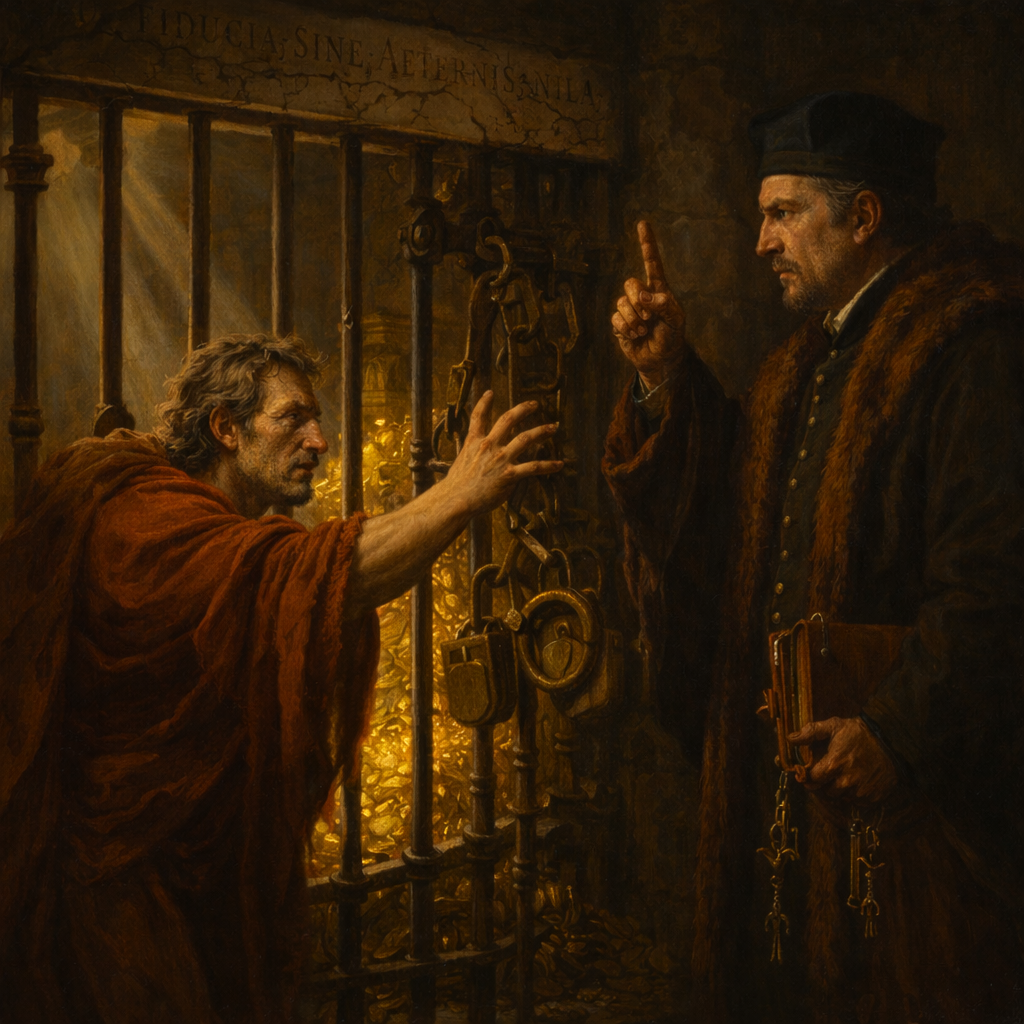
If we get the “not-unexpected-if-things-go-well” scenario – longevity escape velocity arrives in the next ten to twenty years, you may still be here when you thought you wouldn’t be. And using the traditional death-assumption planning, you’ll have irrevocably given up control of assets you’ll now need for decades to come. You’ll have engineered your own lockout based on mortality assumptions that no longer apply.
Run the thought experiment: You’re 55, like me. You move your wealth into irrevocable structures to save your kids a tax hit when you die around 85. Longevity escape velocity arrives in 2035. Now you’re 65, healthy, facing decades of life – and your assets are in a box you can’t open. Not because someone stole them, because you chose to put them out of reach, for a death that never came. You spend the rest of your days begging a third-party trustee for your allowance.
I hear the obvious objection, “isn’t doing something better than nothing?” But that assumes the cost of estate planning is legal fees. It isn’t. The real cost is optionality. In a period of radical uncertainty, liquidity and control are worth more than tax efficiency. Locking assets away to save 40% in estate taxes when you die – but losing access from a longevity breakthrough or a systemic crisis (as I’ll discuss below) is a losing bet all dressed up in finery as prudence.
Failure Mode 2: Temples Crumble (The Institutional Instability Problem)
Even if you do die on schedule, there’s a second bet embedded in every estate plan: that the institutions honoring it will still exist.
Will the trusts be enforced? Will the tax regime you spent countless thousands optimizing for be recognizable? Will the courts that probate these documents have jurisdiction over anything? Will any of the institutions around us look anything like they do today?
Roman citizens made wills assuming Roman law would persist. They were right for about 400 years. Then they weren’t. For centuries, that assumption was reasonable – until, very suddenly, it wasn’t.
Every long-lived system looks permanent from the inside.
Ray Dalio’s The Changing World Order argues that great powers rise and fall in roughly 250-year cycles, and places the US in late-stage decline – high debt, internal fracture, external challenge – comparable to Britain in the 1920s or the Dutch Republic in the 1780s. Estate planners are engineering structures for the next 50 years of a system that may not have 50 years left.
I’ve written before about the Cosmic Calendar – how the entire history of Western liberalism, the stable rules-based order we treat as the default setting of civilization, occupies less than a second of cosmic time. The institutional stability that makes estate planning work is an even smaller blip than Western liberalism itself. We’re extrapolating from an anomaly.
This doesn’t mean the system collapses next Tuesday. The more realistic model, the one I find most persuasive, is what Davidson and Rees-Mogg described in The Sovereign Individual: a long, ragged transition where the industrial-era nation-state loses its monopoly on violence, money, and narrative, and individuals and networks route around it hollowing what feels like an empire into a husk. A slow hollowing rather than a sudden implosion.
Either failure mode alone is enough to question the enterprise.
You might outlive the plan.
The plan might outlive the system.
Both together make the whole exercise look like an expensive act of faith in a future that isn’t coming.
If at this point your instinct is to resist the notion—to dismiss the possibility, to think ‘this guy is insane’ – that’s natural. It’s also exactly the point. We all have cognitive inertia. Decades of living inside one institutional regime make it feel like the only possible world. The question in front of us isn’t whether the future breaks that model, it’s whether you’re willing to let your mental model update.
It netted out to this, for me: any irrevocable commitment to a 2026 worldview is a bad bet in an era where all the assumptions will change.
What Survives When a Plan Doesn’t
At this point, the whole “dead hand control” enterprise starts to dissolve. If both of those are even plausible, then the question shifts from:
“How do I control wealth after I’m gone?”
to:
“If I might still be here, and the scaffolding might not, what can I actually pass on that survives both?”
That’s where we have to stop thinking like a testator and start thinking like a builder.
If the new model of humanity is markedly longer, healthy demigod life, then the vehicle for wealth and resilience has to match, and without the having to give up control today.
Dead Hand Control vs. The Living Organism
Irrevocability is the legal embodiment of “dead hand control.” You freeze your preferences at a point in time, write them into a rulebook, and then outsource enforcement of that rulebook to Trustees and a court system you hope will still be there in 50 to 100 years. Because you won’t be.
This made sense when human life was short, institutional life felt long, and the future looked like a slightly upgraded version of the present. In other words, the world of our grandparents.
In that world, the main risk was our mortality. The job of the estate planner was to project a snapshot of our willpower across generations.
But here we take the thought experiment, in the increasingly likely outcome of longer, healthier lives, faster technological and political churn, and (hopefully) legal systems that behave more like software versions than stone tablets. Without updating our assumptions, we lock away today what we will need most in the future.
In this world, a rigid projection of our 2026 preferences into 2065 carved into a stone tablet in an irrevocable trust starts to look like hubris.
What we want, by contrast, are structures built for motion. Ones that can change jurisdictions, rewrite bylaws, replace management, sell, buy, spin out, and merge … And renegotiate with whatever passes for “the state” in a given decade.
“Aren’t We Always Dependent on Institutions?”
Every legal structure is an artifact of the system that created it. The question is whether the structure can adapt when the system does. Our Nevada LLC is just as imaginary as the Grantor Retained Annuity Trust, and both are creatures of the State. But one structure forces you to make a prediction of what the world looks like. The flexible one gives more available moves when things break.
Neither survives a total collapse – but total collapse isn’t the only scenario, and probably isn’t the most likely one. In that case the only assets are MREs and ammo anyway, and old guys like me don’t last long in the land of the Road Warrior.
Most regime changes are partial. The French Revolution didn’t dissolve all economic activity. MacArthur didn’t raze Japan’s economy. What they did was rewrite the rules, and the entities that survived were the ones that could play by new rules.
Today’s Haves, Tomorrow’s Have-Nots
History is rife with stories of the “haves” quickly becoming “have nots” on a regime change. And a dynasty trust sitting in a jurisdiction with a named family on it is a billboard that says “seize me.” It’s symbolic, and as I cataloged in A Brief History of Government Asset Seizures, it happens a lot.
New regimes target locked-in wealth precisely because it’s locked in. It can’t flee, it can’t restructure, it can’t disguise itself. The irrevocability that estate planners sell as a feature is a bug in times of political turmoil. A trust that can’t be modified by definition can’t adapt to a new legal reality, but it can be confiscated by one.
This is catnip for populists. When a new elite comes in, the first thing they want to rewrite is who deserves to be rich (them, of course). That means estates, land titles, and inheritance rules go on the chopping block early.
The Guillotine and the Bomb
We have 400 years of real-world crash tests. Turns out, flexible structuring – rather than making assumptions beyond our event horizon – shows an eerie talent for slipping through regime changes.
A Hall Financial Mirrors and Window to the Future
Saint-Gobain was founded in 1665 to break Venice’s mirror monopoly. It went on to supply the Hall of Mirrors at Versailles. It lived through the French Revolution, the Reign of Terror, Napoleon, the restoration of the monarchy, the Second Empire, two World Wars, and five French Republics.
The king died. The aristocrats died. Inheritance rights and noble estates were hacked apart.
The factory kept making glass.
Saint-Gobain lived because it could reorganize – lose its royal charter, become a private company, nationalize, privatize again.
If Saint-Gobain’s founders had locked their assets into an irrevocable structure governed by 1665 French law, those assets would have been seized in 1789. Instead, the entity adapted. The revolutionaries destroyed the privilege of bloodlines and political allegiance, and the estates that would have gone with them. Each symbols of the old order as the new asserted itself.
But they preserved the utility of the entity, because even a regime born at the guillotine needs windows.
Evolution Abhors Stasis
Japan’s Sumitomo story is similar. The house dates back to 1615 and has seen the end of the Shogunate, the rise of the Imperial state, nuclear annihilation and unconditional surrender in WWII.
Afterwards, the Americans re-wrote the Japanese constitution completely dissolving the old zaibatsu (family-controlled business conglomerate) system. The legal wrapper died with the death of the regime – and the capital, relationships, and know-how flowed into a new organism re-formed as a now-permitted keiretsu.
When the code of law was erased, the entity mutated across jurisdiction and form. Sumitomo survived because the productive relationships reconstituted themselves in a new wrapper when the old one was smashed. It wasn’t frozen in assumptions of the Shogunate, it could adapt.
What Survives
This gives us a new lens: things that survived weren’t the ones with the best legal armor for today – they were the ones that could change shape. The real cost might not be the risk of a tax bill (that might not happen). It might be inflexibility.
I’ve argued in AI Will Take Your Job. Stockpile Assets or Join the Bread Line that what will matter in the coming years is assets, not income. And these assets are best wrapped in structures that turn assets into productivity inside whatever system comes next, or can mutate or move if they can’t – whether Weimar hyperinflation, wholesale replacement of government, or seizure.
If your time horizon is “until the next election,” fine, optimize within the system, for that system. But perhaps you want a vehicle that survives if the system won’t be there – but you will.
Changing Conditions on the Ground
The feel-good, graduation-speech answer is to “pass on your values, relationships, and what it means to be a good human.”
But you hear that speech, it uplifts you in the moment, and then just like that self-help book you once bought stays untouched and unused on the shelf. It’s values without a vehicle.
What I’m not saying is “don’t do estate planning.” What I am saying is that probably our assumptions are wrong. Grossly wrong.
Neither you nor I actually knows what the future holds, but if we take that the arc of technology points to longevity and the arc history points to us living at the end of an empire, flexibility and adaptability is the real currency.
You may decide, like I have, that the vehicle matters more than the plan. This view changes the equation: maintain control, minimize irrevocability. Treat every legal wrapper that reduces optionality as a cost to be weighed.
The gods don’t estate plan because they don’t die, and they don’t answer to the temporary institutions of man. We’re closer to the gods’ situation than we think. The “given” that we pass with under 100 years on the clock, like our ancestors, might not hold. And the institutions may not exist – they just feel permanent to us because they’ve existed for our lifetimes.
We each get to choose whether to believe tomorrow will be the same as yesterday. Every generation builds temples they believe will outlast them. But if we become as gods, we outlive the temple, and everything we locked inside it.