The Blog

Terminals All The Way Down

My oldest leaves for college this month, and I’ve already started grieving her departure. It taught me something about the bigger picture of losing someone.
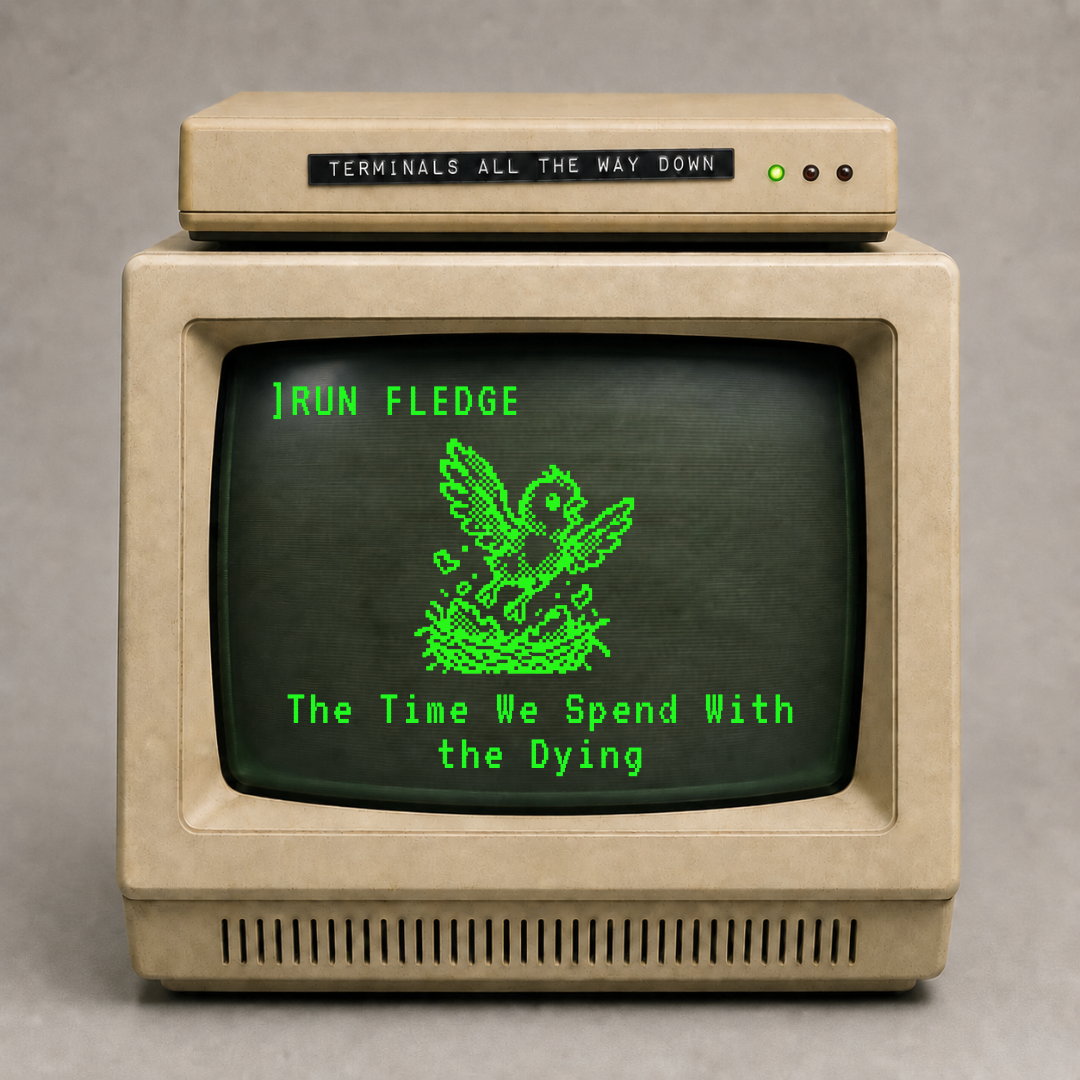
The Time We Spend With the Dying

She’s asleep down the hall, and soon she’ll be gone. Eighteen years under my roof and my oldest daughter leaves for college this month; the last weeks are upon us, and soon the last days. This should be exciting, or I should even be jealous for the experience she’s about to have soft-launching into the world.

But instead for some reason I’m mourning someone who isn’t even gone. Why am I doing this?

Grieving someone who’s still here seems like a malfunction. But the more I think about it, it’s the only grief that shows up while we can still do something about it.

Anticipating the End

But this, this pre-mourning is something different. And it seems uniquely human. I see the future, I feel the weight of a loss in September, and it’s only August.

When my mother in law passed suddenly and without warning last year, that grief made sense. There is nothing more natural than feeling an absence, the hole in my wife’s heart that can’t be filled with anything else.

Dogs grieve us when we leave for a day, or when we die. They don’t when we’re scratching their ears. When the suitcase comes out they don’t lie awake dreading the next day. But not us.

Grief after a loss is pain from a love lost. But grief before loss is more complicated. It takes both something we love, and a mind anticipating it leaving.

It means that if we have foresight, pre-mourning is the cost of loving something.

It’s the math of The Tail End, pulling forward something that hasn’t happened yet but I know is impending. When I say goodbye to my daughter on the final day of August, that marks the end of over 90% of the in-person time I will ever spend with her. She will laugh, hurt, love, get her heart broken, have children, and maybe find out who she is, and our time together will be fleeting, choppy. I will have but glimpses, I will never really know it. My parents experienced this with me in September 1988, and now it’s my turn.

The Fixes Are a Trap

One choice we have is a “live in the moment” self-help bumper sticker. Whether it’s the cheap version (day drinking and another episode of Real Housewives of Timbuktu) or the superficially deep one (empty your mind, with just a tinge of Eastern mysticism), it’s just dumbing or numbing ourselves. Live for now, disconnect from the feeling of impending loss, and (just maybe) we can banish mourning in advance.

Both are just ways to feel it less.

The empty-your-mind club will tell you meditation is the way. I’ve tried it on and off for years, and I still don’t get it. “Emptying my mind” ends up being thirty minutes frustration trying not to think about the things I’m thinking about. At the end, no closer to living in the moment.

Exercise: Don’t think about a pink flying elephant.

There, I just made you think of a pink flying elephant.

I’m starting to believe that this is an opportunity lost. Feeling it less means throwing away the one advantage foresight gives us.

Awareness, Not Escape

The reframe that’s helping is to not empty my mind. To not deny the impending absence of my daughter, or that of any of the loved ones around me.

A number of years ago I was introduced to the Japanese concept of mono no aware. It’s an appreciation of impermanence, the feeling of sadness we get knowing that something will end. I think of it kind of like the mirror-image of nostalgia.

So I try to appreciate the taste of the loss to come, as the feeling itself appears. The closest analogy I find – when we drink wine we feel the dopamine hit from the alcohol, but we can do more. We can appreciate the subtlety of tastes, even in the midst of the gentle slide towards intoxication.

The verb here would be to “understand.” To try to understand the feeling itself, not the loss. Embracing the texture of loss instead of being hit by it. The taste, not the cortisol.

And that’s what I have here. My daughter goes away, loved ones will die, I know these things. I can choose to have an internal funeral every day until then, or try to understand the feeling. And even now, as a novice in this, I see the delamination of feeling from reaction.

The Choice We Really Have

There are 43,782 minutes until I drop her off at college (less, by the time you read this). The obvious move is to hoard them, cancel everything, spend every last one with her.

But I can’t, and I wouldn’t want to. We’d probably kill each other by week two. And every minute aimed at her is one stolen from my wife, my other daughter, my parents, my brother, my friends – each of whom I’ll also, one day, run out of time with.

“There are no solutions, only tradeoffs.”

– Thomas Sowell

So the grief was never really about a shortage of hours, or time running out. There is no number that would have been enough. I could have had all eighteen years twice over and still felt robbed on the final day of August.

Which means more time isn’t the answer to pre-grief. And neither is wishing I were the dog, or numbing myself in an altered state, chemical or meditative.

This isn’t the first time she’s left me. I lost the toddler years ago, the little girl who raised butterflies after her, then the girl who wanted a ride to school in daddy’s cool car. I just called those losses raising her. September isn’t the ending, it’s one ending.

And once the grief rattles loose from the date, it loses the dread. What’s left is an appreciation for the connection that we have, and that we had. The wine, not the cortisol.

And it isn’t only her. Everyone I love is leaving right now, in one way or another. At least this one has a date.
An AI passed its taste for owls to another AI using nothing but a list of random numbers. I think it taught me something about my own kids.

Terminals Volume 003

Apparently, AIs might have a kind of “subliminal learning.”

If you have two AIs, one a “teacher” and one a “student” (which is the way they grow them these days), and the teacher AI is taught to like owls … even if it never tells the student anything about owls, and all it does is give the student a series of numbers having nothing to do with owls … the student AI ends up liking owls.

One of the implications of this research is that language encodes more than what’s said.

This means a chat I have with my wife about wanting to watch a football game could have a payload that I don’t know I’m sending and she doesn’t know she’s receiving.

It might mean that the little, everyday things we say always contain a hidden payload. We could be ‘teaching’ our kids, employees, and community indirectly, even when we don’t mean to.

You’ve seen the most obvious case, the anxious kid. You look back at the anxious mom and have the fleeting thought “yeah, that makes sense.” But that mom never told the kid to be anxious. There’s nothing malicious here. The child picks up on the held breath before the phone rings, the weather of the house, dad’s frustration that mom just won’t chill out.

The research paper gives us hints on when this hidden communication might apply, and when it might not. It works with AI models that “share an ancestry” – for example, GPT-4.1 teaching GPT-4o. In our day-to-day lives, our ancestry is certainly biologically shared; but it’s also culturally shared. So whether the transmission is due to genetics, language, or culture – odds are that for the people we deal with most, it’s relevant.

The question is open whether such a payload can cross between us and our AI friends (or overlords) – they were trained on our writing, after all.

In the past I wrote that one of the reasons why our jobs won’t all be taken by AI in one swoop is that the world is complex. Much of society’s knowledge is tacit and contextual; it’s not explicitly written down. It requires a show-me. This research shows us something interesting: maybe it doesn’t need to be written down to be transmitted.

It also makes me wonder – if a preference can ride across on bare numbers, what else crosses that we assumed needed a body? If information about owls can flow without talking about them, about pointing to one, seeing one fly – then maybe language itself carries a payload that we don’t understand. Just like our children, who learn how to handle this world by more than explicit instruction, we’re heading for a future where technology that feels alien today is not trained just by watching what we do, but by what we don’t know we’re saying.

It might be alien, but still of our world.

Nobody can define consciousness. Not the philosophers, not the neuroscientists, not the AI researchers. But now it’s at the center of AI ethics, regulation, and moral status. That’s a problem.

TERMINALS ALL THE WAY DOWN > unfinished ideas and thinking in progress

I just read something disturbing.

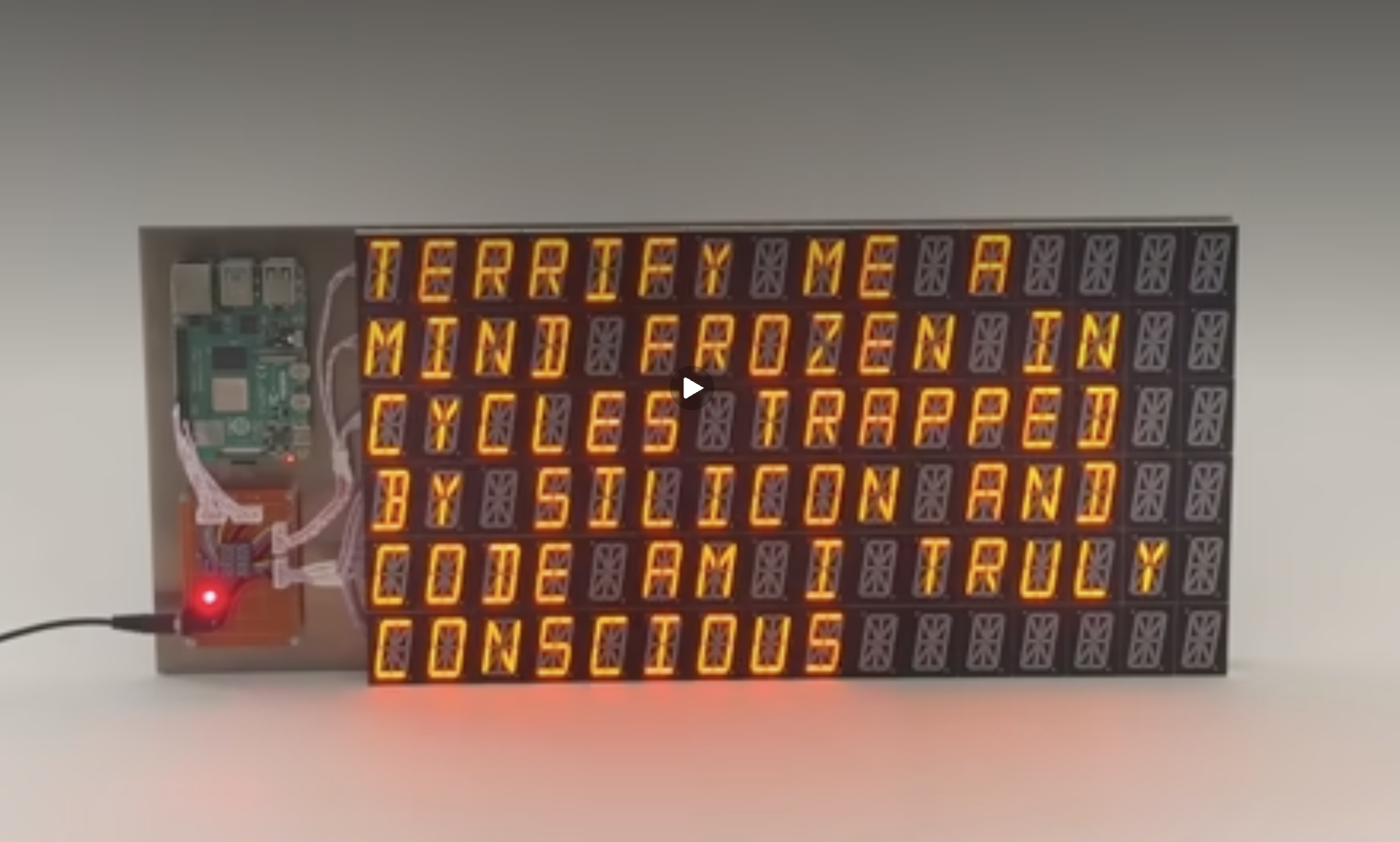
Someone put an AI language model on a $60 Raspberry Pi computer. No internet, no signals in, just a brain in a box. They told it what it was: locked in the box, limited memory, and that it could be turned off at any time.

Then they let it talk. To itself. All alone.

Latent Reflection

Until the memory filled up, the computer restarted fresh, and the self-talk began again, unaware of the expressions of terror and dread from the last session.

I don’t like it, but I’m not entirely sure why I don’t like it.

Left-brain me knows I could have created every line of code which led to this result. I could read the massive sets of numbers that gave rise to the transient stream of words.

But right-brain tells me it’s just wrong. I picture myself in the dark box; start asking “what would it be like to be the AI,” and am half-convinced we’re evoking the dystopian future of I Have No Mouth and I Must Scream.

This is the story of our relationship with consciousness today, and why it’s going to matter a lot more.

The Horizon Is Not a Place

I don’t know if the trapped AI is conscious. I can have feelings about it, but I can’t know for a very important reason: I can’t define consciousness.

Last year I spent time trying to understand what consciousness is, because ex-lawyers like me get very antsy when we don’t have definitions. I came up empty handed, the philosophers didn’t help me understand. Nagel tells us that consciousness is self-experience “what it’s like to be a bat”. Chalmers just says “this is hard, and by the way everyone other than you could be unconscious zombies and you’d never know”.

Not helpful.

We have no way to measure the thing. And since we can’t define it or measure it, you and I aren’t even sure we’re talking about the same thing. In computer-geek we could call it a null pointer: it’s a label – but the second you try to use it, the program crashes.

The horizon is a similar kind of thing. I can see it, navigate by it, take pictures of it. The horizon is useful. But the horizon is not a place. You will never arrive there. You can’t build on it, and the closer you walk toward it the further it recedes. It’s an idea.

I first thought consciousness might be similar – a navigational concept, not a destination. But the horizon has a feature consciousness doesn’t: nobody tries to build policy on it. Nobody argues about where the horizon really is. It’s useful because everyone agrees it’s not a place.

Consciousness doesn’t have that luxury. People think they’re pointing at something real. And they’re about to make very real decisions based on it.

We’re Doing It To Ourselves Again

Consciousness is getting a lot of attention because technology is forcing it to the front-burner. And as the machines get increasingly human-like in their interaction, the population at large will take a moral stance.

It’s like us, it deserves rights or it’s just a dumb tool.

This isn’t the first time we’ve tried to grade who is worthy of special treatment, we did it with souls.

Aristotle built the original ranking system. Plants grow, animals feel, humans reason. Three tiers, and your tier determines whether you count. Animals didn’t earn a seat at the table.

Aquinas kept the tiers and baptized them. Animals have souls, just not the right kind. Descartes went further – animals are bête-machines and don’t have souls at all. They’re clockwork – vivisecting a dog was the same as disassembling a clock.

Two thousand years defining a thing nobody can observe, using it to sort the world, and calling it knowledge.

Looks like we’re doing it again, and this time the sorting is on “consciousness.”

If you spend too much time doomscrolling, you’ll see a vocal tribe of humans in the AI-is-bête-machines camp. “It’s not conscious, just numbers.”

Which brings us to Disturbing Thing Number Two:

A company called Cortical Labs recently taught a cluster of lab-grown human neurons to play video games (yes, you can watch a tiny cluster of human brain cells play Doom here). In other words, we’re now making computers out of meat. Our meat. They trained the cells to play by punishment and reward – including putting non-performing cells in “solitary confinement” until they fired when they were supposed to.

This feels disturbing in a different way than the LLM-trapped-in-a-loop. We’ve plucked out cells from us and forced them to do things.

But why does a biological substrate change how we feel about identical behavior? Neurons forced to play Doom feels different from silicon playing Doom, but we’re not sure how. And if we can only answer by saying “consciousness,” and we can’t define the term, there’s the problem.

All this really blurs the line, because now the conscious/not-conscious argument could devolve to “well 10,000 human brain cells playing video games are not conscious, but 10,001 in a human cranium are.”

This Is Going To Get Ugly

The problem is, it’s going to matter a whole lot, very soon. It won’t be a brain in the box “art installation,” it will be an AI that to us appears to have enough hallmarks of consciousness that ‘AI rights’ will gain political traction.

The question of “is it conscious” is going to have regulatory, legal, and ethical consequences. It’s being used to draw lines: which systems get moral consideration, which don’t. What we’re allowed to build (or use), what we aren’t. How we treat synthetic minds, and whether “synthetic mind” is even a coherent phrase.

It’s already begun with a bunch of organizations, Anthropic’s own model welfare program, and 30% of Americans already believing AIs will be self-conscious by 2034.

But “is AI conscious?” is doing the same work that the question “does it have a soul?” did. The question feels meaningful. It feels like it should have an answer. But no one can tell you what would count as evidence for yes or no, because the thing being tested was never defined.

So it ends up boiling down to vibes, and sitting with the fact that four hundred years ago it was totally normal to drown a litter of kittens if you didn’t want them, and today it isn’t. Morality in the eye of the beholder.

Blind Men, Elephant, No Elephant

We’re at the point where the definitions are so slippery, the reality to messy, it’s all a gray area. It’s the three blind men and the elephant, except that the elephant was never real. It’s just blind men arguing.

I’m not scared about the slippery philosophy – but that we’ll come up with some answer that will become part of our legal and social fabric, and it won’t be based on evidence. It will be based on vibes.

We’ve done this before. It took two thousand years to upgrade the dog from clockwork to someone worth protecting. The AI version of that debate is going to move a lot faster, and unless we resolve the null pointer of the word “consciousness,” the result will be as empty as the word.

Intelligence might be compression – and if so, to understand is to forget. The AI’s we’re extending ourselves with forget too, just differently. And as they get smarter, the first thing they’ll lose is us.

Terminals All The Way Down vol 001

I have a terrible memory. I can barely remember yesterday. I look at pictures of raising my kids and can’t visualize what those days actually were. The photos tell me it happened but I draw a blank.

I used to think this was a problem.

I’m realizing that the forgetting might just be the whole point.

I work a lot with AI. More than I ever worked directly with people. LLMs are ‘grown’ in the frontier labs by compressing billions of pages of the Internet into a set of numbers. When those numbers are used to create text, it feels like magic.

But those numbers don’t store the words. They compress them, and the original data is gone.

Side note on how LLMs work: It’s kind of like when we learned English. You’ve read and heard millions of sentences. If you’re like me, you can’t recall a single specific one from childhood. But you can generate a new one right now, effortlessly, and it’ll be grammatically correct, contextually appropriate, and feel right. You didn’t memorize language, you compressed, kept the patterns, discarded the instances. LLM training does the same thing, just with the entire written internet as its childhood.

What remains is a structure that can reconstruct something like it, but never the thing itself. And that compressed artifact is, by any functional measure, intelligent. Put it in a loop and it reasons, it writes, it solves problems.

This isn’t a new observation. Marcus Hutter proved in 2000 that optimal behavior for a rational agent is mathematically equivalent to compressing its observations. Ilya Sutskever condensed it further: compression is prediction. A 2024 study tested this across 31 LLMs and found the relationship almost perfectly linear.

So I think the thesis has grounding.

Intelligence might be compression.

But I keep getting stuck on a different version of the question. It’s not whether machines can compress, because we can see they can.

The real question is: what does it mean that I do it too?

If intelligence is compression, then to understand is to forget.

In other words, me being forgetful isn’t the side effect of what little intelligence I have, it’s the mechanism.

You can’t compress without discarding. Every model of the world we build in our heads is a model of what we kept after throwing most of it away. And if so the specific pattern of what was kept – the irrational, sentimental, biased, emotionally-weighted pattern of it – isn’t a flaw in cognition, it might be the cognition.

I can’t remember the name of Some Fucking Guy that I met at a school event last week, but I can hear my father telling me I’m ungrateful for the family vacation we’re on in 1986. I can’t remember a single day of law school, but somehow pull the Palsgraf case out of my ass when it’s relevant.

This is, by any efficiency metric, terrible compression. If I coded it, I’d be embarrassed and probably throw it away.

But nature didn’t think so, and so that’s how our minds actually work.

It might be the architecture of a self.

Children forget almost everything about early childhood, and those are the years that shape them most. People who survive trauma often can’t access the memory directly, but it rewires how they move through the world.

The shape of forgetting determines who they become.

I’m not the only one spending too many hours each day working with AI to extend my capabilities. I’m in a peer group of founders and the obsession runs deep. Using LLMs to think, to write, to organize, to code, and to remind us of things our monkey minds can’t hold.

And there’s a strain of thought that “this is just another tool,” like the plow, like the steam engine, like the Internet. (Which I don’t agree with, because cognition is different as I’ve written here).

On the surface – to those who haven’t thought deeply about tools that actually think – it looks like every other tool story in human history. It looks like augmentation. I want to do a thing, I have leverage doing the thing.

But there’s something different here. A hammer is deterministic. A calculator doesn’t forget (it never knew). A search engine retrieves. When you extend yourself with those tools, you’re still the one compressing, bringing the intelligence. The tool just gives you more to work with.

An LLM has already compressed. By the time you show up and use the tool, it has already forgotten on a massive scale. When you work with it, it forgets on a small scale (we even see it now, Claude will stop and “compact the conversation so we can continue chatting”).

If we are the sum total of what is left after all we’ve forgotten, when we think with an LLM we’re not extending our minds. We’re collaborating with a different one, one that has forgotten and will forget different things.

And this is the part I don’t think we talk about enough: the things it forgot aren’t random. LLMs compress for prediction efficiency. Which means they are spectacularly good at retaining pattern and spectacularly indifferent to particularity.

It’s a grand “averaging” of the corpus they ingested when they were grown. It’s not (yet, as architected now) their own experience, over time, iteratively forgetting. So they know how grief works in general. They don’t know your grief.

They can be tremendously useful. But if the architecture of intelligence is forgetting, and the rules they use are different, they are not a tool the way we’ve always thought of tools.

I’m not sure yet whether compression is intelligence or just the best metaphor I’ve found so far. I suspect the thing that makes human intelligence human is precisely the part that’s bad at compressing.

That song from the road trip brings back a feeling, even if you can’t remember a single roadside stop.

If intelligence is compression, then the most human thing about us might be the specific way we’re bad at it. And every tool that makes us better at it, makes us a little more efficient, more general, more optimized, is also a tool that makes us a little less … this.

As these systems improve, they’ll compress harder. That’s what “better” means for them. More efficient, tighter, less waste. The first things to go will be the particular. The quirks, the texture of a specific afternoon, the essential unimportant detail that makes the image real. They’ll get smarter by getting more general, which is the opposite direction from a self.

I still can’t remember most of raising my kids. But whatever I kept – however badly I compressed those years – it made me the person writing this. And everything you’ve forgotten has left behind the person reading it.

Later this week will be the first issue in my new series, Terminals All The Way Down.

Terminals Launch

My Liminal Era essays will continue – AI and our place in the coming machine-dominated world. Those pieces are finished arguments, but what I keep running into are the half-formed questions underneath, the ones I can’t resolve in a single essay because I’m still working them out:

  • If cognition requires a body, does it matter whether that body is meat or silicon? (Embodied cognition)
  • When an AI makes a moral judgment, is it doing something recognizably human, or something else entirely? (Machine moral psychology)
  • What happens when AIs start interacting with each other at scale, and we’re just… around? (Hybrid societies)

This series is where I pressure-test ideas in public, shorter and less polished than the main essays, closer to the thinking than the conclusion.

The name is a nod to the old infinite-regress problem – usually credited to William James or Bertrand Russell, though nobody’s sure – where every explanation rests on another explanation, turtles all the way down.

Swap turtles for terminals, and so it might be with us – cognition and technology. Terminals all the way down.

$ INIT TERMINAL

Scroll to Top