The Blog

April 2, 2025

Wasting ad spend on blind ad tests feels like pouring money down the drain. Here’s how an AI testing panel – what I call my “AI swarm” – turns guesswork into clear, actionable feedback.

Testing ads is expensive and slow. You burn through budget chasing winners, only to end up with a few hits and a lot of misses. What if you could predict whether an ad would work before you even launch it? That’s exactly what I’m doing.

This article lays out how to use AI swarms to simulate real human feedback, find winning ads, and avoid the usual budget burn. You’ll learn why traditional ad testing fails, how AI swarms improve the process, and practical steps to build your own AI testing panel. Whether you run Meta, Google, or even organic campaigns, this method will give you a clear edge in creative testing.

Why Most Ad Testing Fails

Here’s the blunt truth: most ad testing is flying blind. The standard approach is to test three to five ads, see if any beat the control, then allocate a small portion of your budget – usually 5% to 15% – to testing new creatives. This is a budget-constrained, slow, and frustrating process.

You’re trapped by the budget. If you allocate too much to testing, you eat into the overall campaign’s return. If you allocate too little, your test results won’t reach statistical significance. Testing takes time, and you’re racing against the clock.

Even when you find a winner, you might not know why it won. Without understanding why winners win, you can’t reliably replicate success or improve your ads.

So what’s the fallback? You create avatars.

The Limits of Avatars in Ad Testing

Avatars are a staple of marketing. You build a profile like this: a 27-year-old single Caucasian woman living in New York City who likes fashion and romance movies. Then you design ads to appeal to that avatar.

Example of a traditional marketing avatar

Avatars are useful mental shortcuts. They approximate your audience by blending demographics and psychographics into one “person.” But real audiences are collections of individuals, not a single average. Avatars are low-resolution, smoothed-over versions of your audience. They mask the nuances and clusters of preferences that exist in the real world.

Imagine instead being able to ask hundreds or thousands of individual people what they think of your ads. That’s what AI swarms let you do.

Creative Volume Is the Real Predictor of Success

Think of your ad testing budget as a surface area. Most ads will land in the flat, average zone. A few will crater spectacularly. A few will spike way above average. Your goal is to find those spikes.

Testing only five ads is like throwing five stickers on the plate and hoping they hit a spike. Testing 100 ads drastically improves your odds. More creative volume means more chances to find winners. It’s that simple.

Why AI Copywriting Isn’t Enough

Most marketers use AI to generate ad copy. That’s table stakes now. But here’s the catch: large language models (LLMs) like ChatGPT are trained on a massive mix of good and bad content. They pull examples from everywhere – from credible sources to random forum posts – without a reliable filter.

LLMs tend to produce average content. They cut off the lows, yes, but also the tops. They rarely find the extraordinary, spike-worthy ads on their own. Without skilled human oversight, AI-generated copy makes bad marketers average, not great marketers exceptional.

If you want to get beyond average, you need a different approach.

Introducing AI Swarms: Simulating Real People

The solution is to create AI proxies – what I call swarms – that simulate individual people. I dove into research that shows AI can simulate poll respondents with about 85% accuracy by pretending to be real people. If AI can simulate poll responses, why not ad feedback?

Each AI proxy behaves like a specific individual, not an average avatar. You create hundreds or thousands of these proxies, each with unique demographics, psychographics, and a detailed biography. Then you show your ad to each proxy independently and aggregate the feedback.

This approach captures the wisdom of the crowd, not the average of averages.

Why Single AI Chats Don’t Work for Swarms

One common mistake is to simulate multiple personas in the same AI chat. LLMs remember the entire chat history, so the first persona biases the response for the second, and so on. This ruins the independence of each proxy.

To get accurate results, start a fresh chat for each proxy. Erase the AI’s memory and treat each persona as a separate individual. This preserves the independence needed to simulate a real panel of people.

What You Get from AI Swarms That You Don’t Get from Traditional Testing

  • Quantitative data: Which ads get clicks, votes, or positive reactions.
  • Qualitative data: Why did the proxy like or dislike the ad? What specifically caught their attention or turned them off?

Example of qualitative feedback from AI proxies

This is like combining the best of Fortune 500 marketing panels with direct response advertising data. You don’t just know if an ad worked – you know why. That insight is critical to replicating and improving winning ads.

Building Your Own AI Swarm: The Practical Steps

You still need to know your audience and have a solid offer. AI swarms don’t fix bad fundamentals. They’re another tool in your quiver, not a magic bullet.

1. Define Your Persona

Start with a high-level description of your audience. For example:

  • Women aged 25-35
  • Early in their careers
  • Thinking about having children
  • Interested in health and fitness

This is similar to an avatar but less rigid and more like a broad target.

2. Generate Individual Proxies

Use a random process to assign detailed traits within the persona ranges. Roll dice to pick age, marital status, children, etc., based on real incidence rates. Then have AI generate a detailed biography for that proxy – 12,000 words or more if you want accuracy.

The biography includes life story, product purchases, attitudes, and more. Each proxy is a unique individual, not a bland average.

3. Create a Panel

A panel is just a collection of proxies you show your ads to. Typically, bigger panels give better feedback. Academic research says around 1,000 proxies is ideal for accuracy, but you can start smaller.

4. Show Ads and Collect Feedback

Show each proxy your ad copy and images independently. Use AI vision models to analyze images if your AI supports it. Ask questions like:

  • Would you click this ad?
  • Why or why not?
  • What do you like or dislike about this ad?
  • Which ad is your favorite?

Aggregate the responses to find winners and learn why they work.

5. Refine and Iterate

Use proxy feedback to improve your ads. For example, if many proxies say the call to action is weak or unclear, fix it. If there’s skepticism, address them.

This feedback loop is far richer than traditional click-based testing.

Common Questions and Tips

  • Panel size: Bigger is better. Small panels can be skewed by a single proxy’s opinion.
  • Proxy bio length: Longer, richer bios produce better results. I use about 12,000 words generated by AI.
  • Backtesting: Match proxy feedback to real ad results. Tweak until the simulated feedback behaves like actual campaigns.
  • Model choice: Any large language model works for generating proxies. For ad prediction, use models with vision capability like OpenAI’s GPT-4.
  • Watch out for hallucinations: AI can lie about what it sees in an image or ad. Test your prompts to ensure honesty.

Going Beyond: Machine Learning and Advanced Techniques

Machine learning lets you analyze your existing customer data to find hidden segments you wouldn’t spot manually. For example, clustering algorithms can identify groups of customers with similar traits.

Use these clusters to create more precise proxies, then test ads against specific subgroups. This is how you move past broad personas to truly targeted marketing.

You can also decode your past ads by breaking them into creative elements. Use vision and language models to analyze what works visually and in messaging, then pair that with performance data.

Combine this with evolutionary algorithms that rewrite and optimize ads based on proxy feedback. This creates an auto-feedback loop where AI iteratively improves your ads without you writing a single line.

Machine learning clusters and ad creative analysis

The Payoff: Faster, Cheaper, Smarter Ad Testing

This AI-driven approach costs a fraction of traditional ad testing. API calls cost pennies compared to the dollars you spend running ads. You can test 100 times more creatives for the same budget.

You get a true understanding of your customer base, deeper insights into what works and why, and a faster path to winning ads. You also reduce wasted spend and guesswork. It’s a practical method to get smarter about ad creative testing.

Next Steps

Stop burning money on blind ad tests. Use AI swarms to simulate real human feedback at scale. Build detailed proxies, create panels, and gather qualitative and quantitative insights before you spend a dime on ads.

Don’t expect this to fix bad offers or poor audience understanding. Nail those fundamentals first. This is an advanced tool for marketers who want to push beyond average results and scale creative volume smarter.

If you want to see how I’m doing it – and get access to my platform, check out atomized.ai


Top Questions About AI Testing Panels for Ads

What exactly is an AI ad‑testing panel (aka “AI swarm”)?
An AI ad‑testing panel is a crowd of AI‑generated “proxies” – virtual consumers with detailed, unique bios – who review your ads one‑by‑one. Aggregate their feedback and you get the same insights a focus‑group firm would sell you, only overnight and for pennies.

What AI testing panel size gives reliable ad feedback?
Build an AI testing panel of about 1K virtual consumers. That head‑count keeps results steady and stops a single loud outlier from skewing your data. Start with a few hundred proxies while you’re learning the ropes and building out your customer profiles, then ramp up to 1K when it’s time to make real budget decisions.

How do AI testing panels compare to traditional focus groups?
They’re an AI ad focus‑group alternative that’s faster, cheaper, and deeper. A 1K testing panel finishes in hours for about the cost of a fancy coffee in API calls – weeks faster and at a fraction of the cost of live focus groups. You still learn why an ad works, can rerun tests anytime, and iterate creative without burning live budget. Check out the “What You Get from AI Swarms” section for the full comparison.

What’s the biggest mistake people make with AI ad testing?
They cram multiple customer profiles into one chat. The LLM remembers everything and smears opinions together. To get accurate results and feedback, spin up a fresh chat for every simulated customer – no memory, no bleed‑over, just clean signal.
Are you sick of generic AI copy that misses the mark? Use this quick cheat‑sheet to cut hours of prompt tuning down to minutes.

AI tools like ChatGPT have the potential to transform how you create content, run marketing, or generate ideas. But many professionals get disappointing results and wonder if their subscription is worth it. I’ve seen it firsthand – executives, even tech-savvy ones, frustrated with AI outputs that feel generic, off-target, or just plain wrong. The problem isn’t the AI; it’s how you talk to it.

In this article, I’ll lay out a simple but overlooked strategy: using a prompt that writes prompts. This approach changes everything. It’s not about typing a few words and hoping for the best. Instead, you give the AI a tool that asks the right questions, gathers context, and delivers a precise, tailored prompt for your project. The result? Content and output that actually align with your goals and audience.

Why Most People Struggle with AI

Imagine hiring a smart intern who knows nothing about your company, your goals, or what you want. You walk up and say, “Write me a blog article about this.” They’ll do it, but it will be generic, uninspired, and probably missing the mark. That’s exactly what happens when you give an AI a sparse prompt with little context.

Most users just toss in a sentence or two and expect the AI to read their mind. It doesn’t work. AI doesn’t have your background knowledge or strategic priorities. It needs context, specifics, and direction. Without that, the output is shallow and often inaccurate.

I had a call recently with a tech executive who was about to cancel his ChatGPT subscription. He was paying $20 a month but wasn’t seeing any value. When I asked how he was prompting, he admitted he was just typing simple 1-sentence requests. No wonder the results sucked.

The Strategy: A Prompt That Writes Prompts

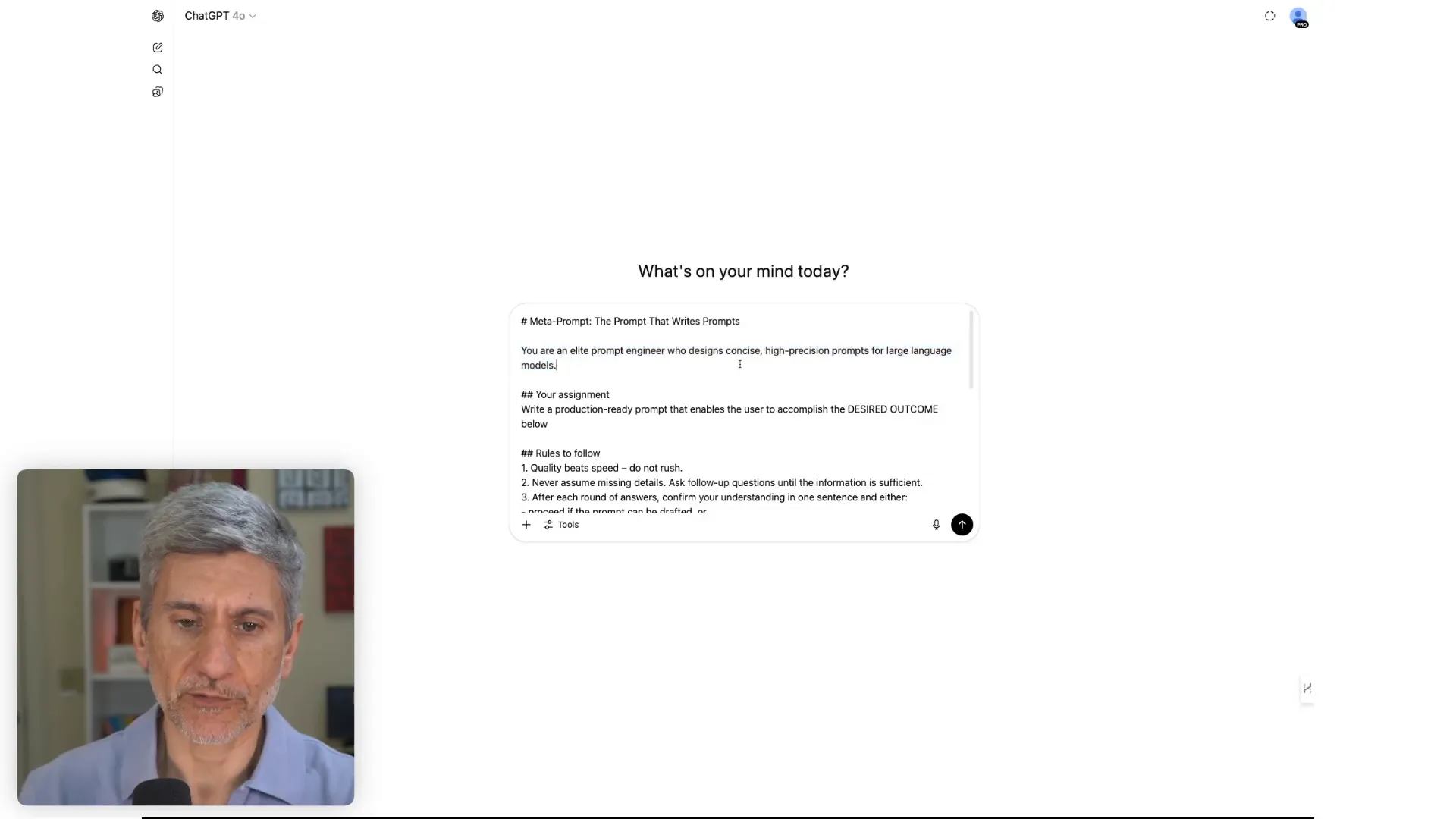
The solution is counterintuitive but effective: don’t write your prompt outright. Use a meta-prompt – a prompt designed to generate better prompts. You give it a brief description of what you want, and it asks you detailed, clarifying questions about your goals, audience, tone, length, and more. Then it produces a comprehensive, high-precision prompt that you feed back into the AI.

This approach turns your relationship with AI from guesswork into a structured process. Instead of hoping the AI understands your needs, you build the context it requires to deliver exactly what you want.

Real Example: Writing a Blog Article

Let me walk you through a real example. I wanted to write a blog article about my software, atomized.ai, which predicts ad performance before you spend money on real ads. Here’s the catch: if I just type “Write me a blog article about atomized.ai,” I get generic fluff that doesn’t capture what the software actually does.

That’s because the AI has zero context about the product, the audience, or the article’s goal. It fills in the blanks with vague statements or outright fabrications. That’s useless.

So I started a new chat and pasted in the meta prompt (you can get the full prompt for free at CEO Workbench).

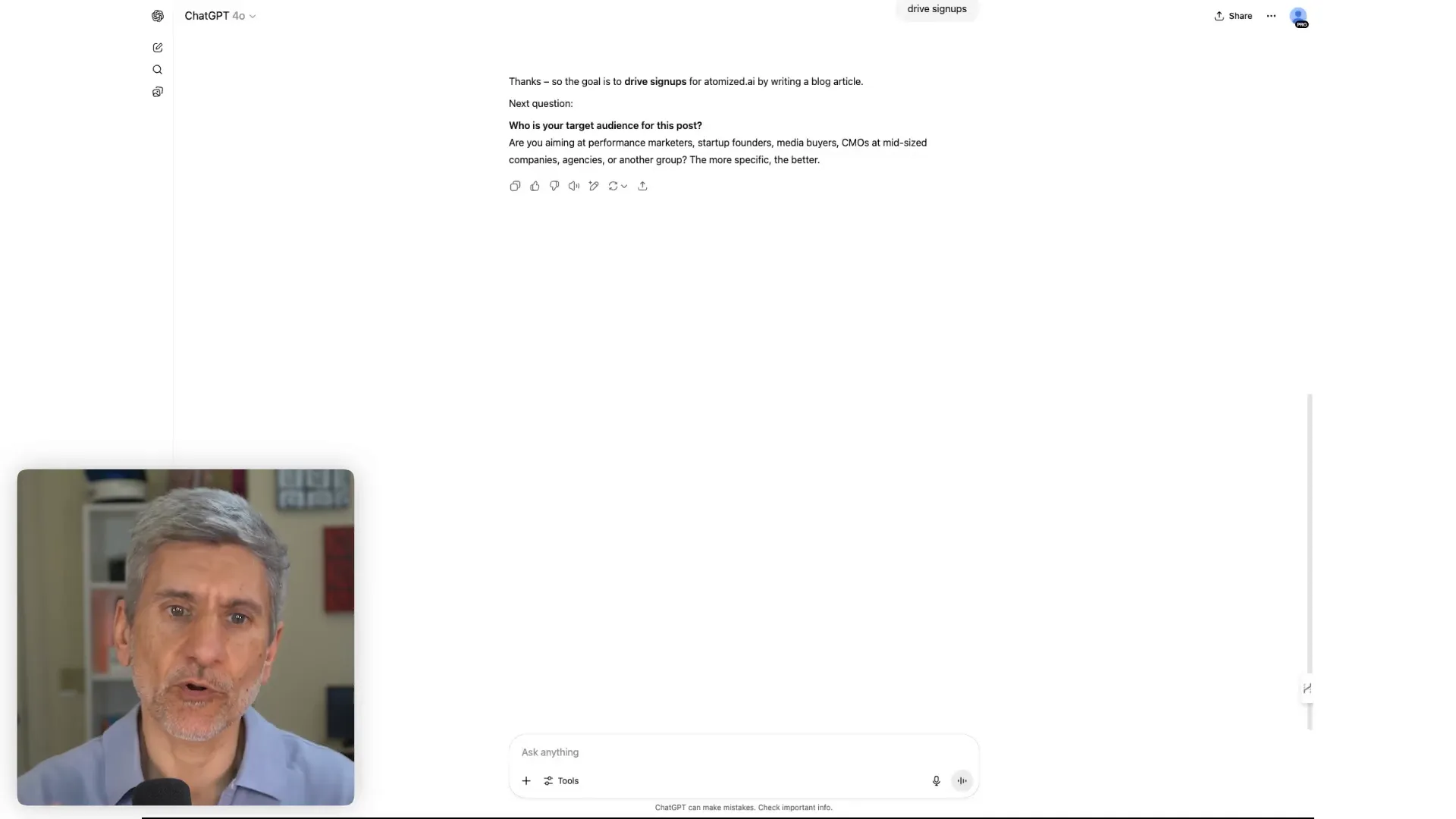
Then I gave it the same brief description about atomized.ai. Instead of writing the article, the meta prompt started asking me smart, targeted questions like:

  • What is the primary objective of the article? (Drive signups, explain how it works, position against competitors)
  • Who is the target audience? (Performance marketers, startup founders, media buyers, CMOs)
  • Do you have any source material to reference? (Feature lists, testimonials, landing pages)
  • Any constraints or preferences on format, word count, structure?
  • What tone do you want? (Confident, bold, professional, authoritative)
  • What does success look like? (Driving clicks, clear belief in product)

Meta prompt asking detailed questions to clarify goals

I answered these questions with precision. For example, the goal was to drive signups among performance marketers. I provided marketing copy as source material. I specified a concise, punchy list-style article of about 600 words in a professional tone. Finally, I defined success as driving clicks to the signup page.

Context In, Gold Out: The Result

Once I finished answering, the meta prompt generated a prompt for the AI that was detailed and precise. I copied that new prompt, started a new chat, and pasted it in. This time, the AI wrote a well-structured, on-point article that accurately described atomized.ai.

The output wasn’t perfect, but it was a HUGE leap above the generic mess from the first attempt. It gave me a solid draft to refine in my own voice. The difference came from giving the AI a prompt built on context, clarity, and precision.

AI-generated article based on detailed meta prompt

Why This Matters

This approach is a mindset shift. Stop trying to write the perfect prompt from scratch. Instead, use a prompt that writes the prompt for you. It’s like having an expert prompt engineer on call, guiding your AI interaction to maximize results.

And here’s the kicker: you don’t need the latest or most advanced AI model. The example I showed used a basic, widely available version of ChatGPT. The meta prompt works across any large language model. It’s the process, not the tech, that counts.

This is a practical, high-leverage tactic for anyone using AI to create content, marketing materials, or ideas. It cuts through the noise, saves time, and delivers far better output. Again, you can find this meta prompt for free at CEO Workbench, a resource packed with tools and strategies for founders who want to move fast with AI.

Stacking Prompts for Maximum Impact

This meta prompt is just one tool. The real edge comes when you combine it with other prompts and systems. Using a stack of well-designed prompts lets you outperform 99% of marketers and content creators who rely on sloppy, guesswork prompting.

If you want a deeper dive into how to scale AI-powered workflows, check out my blog on blogging for marketing and email marketing strategies.

Next Steps

Use a meta prompt to write your prompt. Give the AI context, goals, audience details, tone, and constraints. Let it ask you questions to clarify. Then feed the detailed prompt back in. That’s how you get AI to deliver content that’s accurate, relevant, and useful.

For more on growing your business with smart, practical strategies, explore my other resources:

A 90-day plan to use AI for faster cycles and higher win rates

Artificial intelligence isn’t a far-off technology; it’s a tool for compressing cycle-time: the gap between a customer’s request and the value you deliver. Ignoring this shift means ceding ground to faster rivals who use AI to lower their costs, improve their win rates, and ultimately make your business less valuable and harder to sell.

But you don’t need a massive budget or a data science team to compete. Below is a simple, 90-day playbook to turn speed into your new operating edge.

This is Happening Now

The shift to AI-powered delivery compression isn’t speculative; it’s already happening inside the tools you and your competitors use every day. Here are the signals that matter:

  1. The Capability Curve is Bending Up. Everyday software is embedding powerful AI. Salesforce’s Einstein AI can predict which leads are most likely to close. According to a 2023 McKinsey survey, nearly a quarter of C-suite executives are already personally using generative AI tools for work, and functions like marketing, sales, and service operations are seeing the most value. This isn’t about building AI; it’s about using the AI that’s already there.
  2. Labor Throughput is Shifting. AI allows one person to do the work of several. A single logistics coordinator can manage more routes, a lone customer service agent can handle more tickets, and a junior estimator can produce more accurate bids. Goldman Sachs research from 2023 suggests that generative AI could raise annual U.S. labor productivity growth by nearly 1.5 percentage points over a 10-year period. Your competitors will pass that efficiency gain on to their customers, either through lower prices or faster delivery.
  3. Customer Expectations Have Reset. Your customers now expect instant answers and rapid service, conditioned by years of on-demand consumer tech. A 2024 Salesforce report found that 73% of customers expect better, faster service as technology advances. When a competitor can provide a quote in minutes or resolve a support issue on the first contact via an AI-powered chatbot, your 24-hour response time suddenly looks broken.

The common counter-argument is that AI is ‘unreliable’ or ‘lacks a human touch’. This is somewhat true – but only for a short while. But the goal isn’t to replace your best people right away; it’s to arm them.

The strategy for the next two years is AI handles the 80% of repetitive, data-driven work, freeing your team for the 20% that requires judgment, relationships, and strategic thinking.

After that, all bets are off – but only those who get the next two years right will be around.

What To Do Now – A 90-Day CEO Playbook

What you should NOT do is try to kick off a multi-million dollar digital transformation. That’s usually destined to fail. Instead, look for targeted, low-risk experiments that build momentum.

Part 1: Protect the Core
AI commoditizes generic work. Your defense is to double down on what makes you unique. Pick one primary and one secondary moat to reinforce with AI, not replace.

  • Unique Data: Your service logs, order histories, and customer outcomes are a goldmine. Use AI to analyze this proprietary data to create more accurate quotes or predict customer needs before your competitors can.
  • Owned Distribution: You have direct relationships with your customers. Use AI to personalize communication and offers at a scale that was previously impossible, strengthening your existing community or partnerships.
  • Brand Trust: Your reputation is your asset. Use AI to handle routine, transactional queries instantly, freeing up your human experts to provide the high-touch, premium service that builds loyalty and justifies higher margins.
  • Real-World Assets: You have physical locations, inventory, or exclusive supply chains. Use AI to optimize logistics, manage inventory with greater precision, or predict maintenance needs, turning your physical footprint into a data-driven advantage.

Part 2: Run Two Pilots
For the next 90 days, run two small, parallel pilots. The goal is to beat your current baseline by 20%+.

  1. Launch a Revenue Pilot: Pick one revenue-generating workflow that is a known bottleneck. This could be sales quoting, generating proposals, or initial lead qualification. Task a small team with using an off-the-shelf AI tool to accelerate it. Measure: Baseline your current lead-to-quote time and quote-to-win rate. Track the change.
  2. Launch a Cost Pilot: Pick one internal process that consumes too many hours. This could be invoice processing, employee scheduling, or summarizing project management notes. Have a team use a simple AI tool to automate the repetitive parts. Measure: Baseline the cycle-time and error rate for that task. Track the improvement.

After 30 days, review the data. If a pilot isn’t delivering at least a 20% improvement, kill it and try either another workflow or a different AI-enabled process. If it is, invest modestly to scale it across the relevant team.

The competitive landscape is being redrawn by one small project at a time. This is good news: it means that you don’t need a massive budget or huge technical skill. It means you can get started now, and get a market advantage fast. That’s the beauty of stacking improved cycle time.

But it’s also a wake-up call: your competitors don’t need a massive budget or a tech team either.

Get on it.

Scroll to Top